

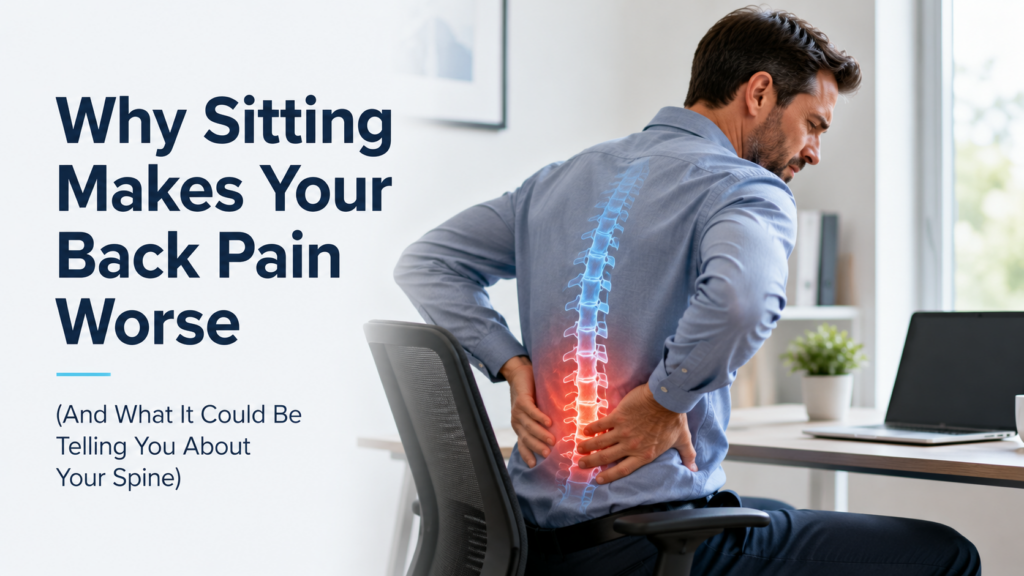
If you’ve ever stood up after a long meeting, a road trip, or a day at your desk and immediately felt pain in your lower back, you’re not alone. One of the most common questions spine specialists hear is:
“Why does my back hurt more when I sit?”
It seems counterintuitive. Sitting doesn’t involve lifting heavy objects or intense physical activity, so why does something as simple as sitting often make back pain worse?
The answer lies in the way sitting affects your spine.
While sitting may feel like a restful position, it actually places significant pressure on the spinal discs—often more than standing or walking. For people with underlying spinal conditions such as herniated discs, bulging discs, annular tears, degenerative disc disease, or sciatica, prolonged sitting can increase pressure on damaged discs and irritate nearby nerves.
For many patients, sitting-related back pain is one of the earliest signs that something deeper may be happening within the spine.
In this guide, we’ll explain:
- Why sitting increases back pain
- How spinal discs respond to prolonged sitting
- The most common spinal conditions that make sitting painful
- Why your pain may improve when you stand or walk
- When sitting-related back pain may require evaluation
- Modern treatment options for chronic spine pain
Understanding why your back hurts while sitting is the first step toward identifying the root cause and finding lasting relief.
Why Sitting Places More Pressure on Your Spine Than Standing
Most people assume that sitting gives the back a chance to rest.
In reality, the opposite is often true.
When you sit, especially with poor posture, the natural curve of the lower spine begins to flatten.
This change shifts more pressure onto the intervertebral discs—the soft cushions between the bones of the spine.
Research has shown that sitting can create greater pressure inside spinal discs than standing, particularly when leaning forward toward a computer or mobile device.
Over time, this increased pressure can aggravate existing spinal problems and contribute to ongoing pain.
Understanding How Your Spinal Discs Work
The spine is made up of vertebrae separated by flexible discs.
Each spinal disc has two important parts.
Annulus Fibrosus
The strong outer ring that provides stability.
Nucleus Pulposus
The soft, gel-like center that absorbs shock during movement.
Healthy discs distribute pressure evenly.
Damaged discs do not.
When a disc develops small tears, begins to bulge, or herniates, sitting often becomes much more uncomfortable because pressure increases directly within the damaged disc.
Why Sitting Makes Disc Pain Worse
When sitting, several things happen simultaneously.
The spine becomes compressed.
The hips rotate backward.
Core muscles become less active.
Pressure shifts toward the lower lumbar discs.
If those discs are already injured, inflammation and nerve irritation increase.
Patients often describe the pain as:
- aching
- burning
- pressure
- stiffness
- sharp pain when standing up
Many notice that walking temporarily improves symptoms because movement redistributes pressure across the spine.
1. Herniated Discs
One of the most common causes of sitting-related back pain is a herniated disc.
A herniated disc occurs when the soft center of the disc pushes through a tear in the outer layer.
When sitting, the pressure inside the disc increases.
This may cause:
- lower back pain
- pain down the leg
- numbness
- tingling
- sciatica
Patients often say:
“I can walk just fine, but sitting for 20 minutes is unbearable.”
2. Bulging Discs
Bulging discs do not always cause symptoms.
However, prolonged sitting can cause the bulging disc to press more firmly against nearby nerves.
Symptoms may include:
- dull lower back pain
- stiffness
- discomfort after long drives
- pain that improves with walking
3. Annular Tears
One of the most overlooked causes of sitting pain is an annular tear.
The annulus fibrosus forms the tough outer wall of the spinal disc.
Small cracks may develop over time because of:
- aging
- repetitive stress
- previous injuries
These tears allow inflammatory substances to leak from the disc.
Sitting increases pressure inside the disc, causing more leakage and greater nerve irritation.
Patients often notice:
- pain while sitting
- pain when bending forward
- pain after getting out of a chair
- recurring episodes of back pain
Because annular tears may not always be visible on routine MRI scans, they are frequently overlooked.
4. Degenerative Disc Disease
As discs age, they lose water content and become thinner.
This process reduces their ability to absorb pressure.
Sitting may cause:
- stiffness
- aching
- reduced flexibility
- worsening pain throughout the day
Many patients notice symptoms improve once they begin moving.
5. Sciatica
Sciatica occurs when the sciatic nerve becomes compressed or irritated.
Since sitting increases pressure on the lumbar discs, many patients experience worsening leg symptoms while seated.
Symptoms include:
- burning pain
- numbness
- tingling
- pain traveling below the knee
Long car rides are a common trigger.
6. Poor Posture
Modern lifestyles contribute significantly to chronic back pain.
Hours spent:
- working at a computer
- using smartphones
- sitting on soft couches
can gradually overload the lower spine.
Poor posture often leads to:
- rounded shoulders
- forward head posture
- flattened lumbar curve
These changes increase stress on spinal discs.
Why Standing Often Feels Better
Patients frequently ask why walking helps while sitting hurts.
Walking allows:
- spinal discs to unload
- muscles to activate
- joints to move
- blood flow to improve
Movement also reduces stiffness that develops during prolonged sitting.
This is why many spine specialists encourage patients to avoid remaining seated for long periods.
Is Sitting Causing Permanent Damage?
Not necessarily.
However, prolonged sitting can accelerate problems if an underlying disc injury already exists.
Over time, excessive pressure may contribute to:
- disc degeneration
- worsening annular tears
- larger disc herniations
- recurring sciatica
Early intervention can often prevent progression.
Signs Your Sitting Pain Could Be Spine-Related
Back pain while sitting should be evaluated if you also experience:
- pain lasting longer than six weeks
- numbness
- tingling
- leg weakness
- pain below the knee
- recurring episodes
These symptoms may indicate nerve involvement.
How Spine Specialists Diagnose Sitting-Related Back Pain
Diagnosis begins with understanding when symptoms occur.
Your physician may ask:
- Does sitting always make it worse?
- Does walking improve symptoms?
- Does pain travel into the leg?
Additional evaluation may include:
Physical Examination
Testing:
- strength
- reflexes
- flexibility
- sensation
MRI
MRI helps evaluate:
- disc herniations
- nerve compression
- spinal stenosis
Specialized Disc Evaluation
Some patients with persistent pain may require further evaluation to determine whether internal disc injuries such as annular tears are contributing to symptoms.
Treatment Options
Treatment depends on the cause of pain.
Conservative options include:
Physical Therapy
Exercises focus on:
- improving posture
- strengthening core muscles
- reducing spinal pressure
Ergonomic Adjustments
Simple workplace improvements include:
- lumbar support
- adjustable chair
- standing desks
- monitor positioning
Anti-inflammatory Medication
May reduce irritation around spinal nerves.
Image-Guided Injections
Can provide temporary relief for selected patients.
Minimally Invasive Spine Treatments
For appropriate candidates, minimally invasive procedures may address the source of disc-related pain while preserving the natural structure of the spine.
Treatment recommendations depend on the patient’s diagnosis, overall health, and severity of symptoms.
Tips to Reduce Sitting-Related Back Pain
You can reduce stress on your spine by:
- standing every 30 to 45 minutes
- maintaining proper posture
- using lumbar support
- keeping both feet flat on the floor
- strengthening your core
- avoiding slouching
Small changes throughout the day can significantly reduce pressure on spinal discs.
Frequently Asked Questions
Why does my back hurt only when I sit?
Sitting increases pressure within the spinal discs, which can aggravate disc injuries and nerve irritation.
Is standing better than sitting?
Alternating between sitting and standing is generally healthier than remaining in one position for extended periods.
Can sitting cause a herniated disc?
Prolonged sitting alone is unlikely to cause a herniated disc, but it can contribute to disc degeneration and worsen existing spinal problems.
Should I stop exercising if sitting hurts?
In many cases, gentle movement and exercise are beneficial. A spine specialist or physical therapist can recommend activities appropriate for your condition.
Final Thoughts
Back pain while sitting is not something you should simply accept as part of getting older or working at a desk.
For many people, it is an early warning sign that the spine is under stress and that an underlying condition—such as a herniated disc, bulging disc, annular tear, degenerative disc disease, or sciatica—may be contributing to symptoms.
While improving posture and reducing sitting time can help, lasting relief often depends on identifying the true source of pain.
If sitting consistently worsens your back pain or your symptoms continue despite stretching, exercise, or conservative treatments, consulting a spine specialist can help determine the underlying cause and guide you toward the most appropriate treatment options.
Early diagnosis can make a significant difference in preventing chronic pain, preserving spinal function, and helping you return to the activities you enjoy most.
