

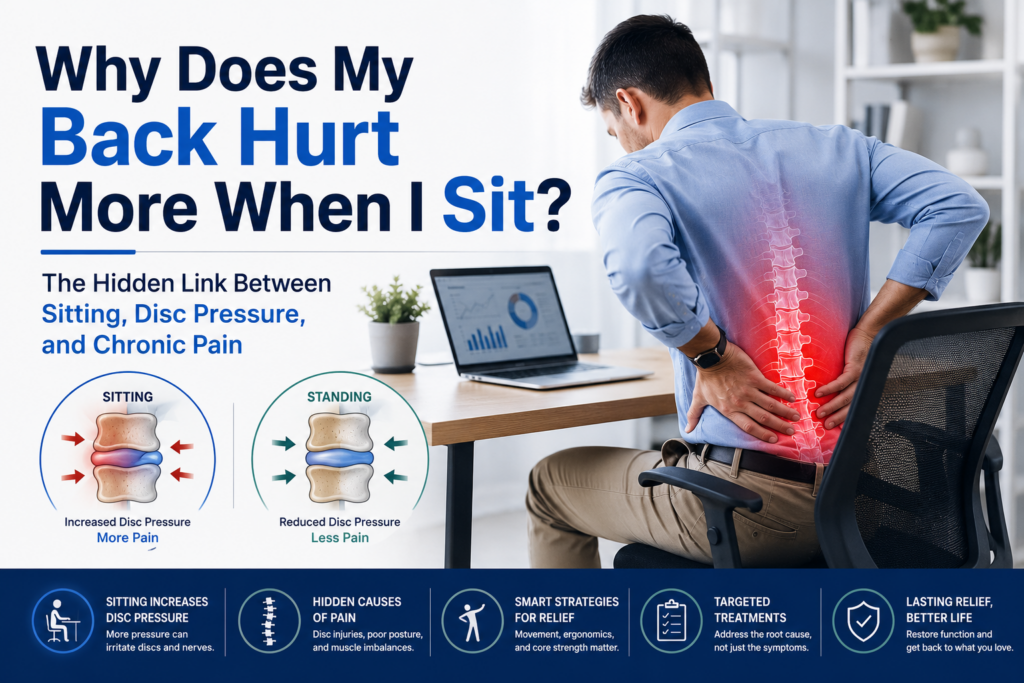
Why Does My Back Hurt More When I Sit?
One of the most common questions spine specialists hear from patients is surprisingly simple:
“Why does my back hurt more when I sit than when I stand or walk?”
For many people, the pain seems completely backwards. Sitting feels like a resting position. It does not appear physically demanding. Yet countless patients report that their worst symptoms occur while sitting at a desk, driving a car, commuting on a train, flying on an airplane, or relaxing on the couch.
For patients throughout New York City and Connecticut, this issue has become increasingly common. Modern lifestyles often involve long hours spent seated at work, extended commuting times, frequent travel, and reduced daily movement. Over time, these habits can place tremendous stress on the spine and may contribute to chronic pain conditions that become progressively more difficult to ignore.
The truth is that sitting places unique mechanical forces on the spine that many people never realize. In fact, sitting often creates more pressure inside spinal discs than standing.
Understanding why this happens can help patients identify the true source of their pain and determine which treatment options may provide lasting relief.
The Spine Was Designed for Movement
The human spine is remarkably strong and flexible.
Its primary functions include:
• Supporting body weight
• Protecting the spinal cord
• Allowing movement
• Absorbing mechanical forces
• Maintaining balance and posture
What many people do not realize is that the spine performs best when it moves regularly.
The body was not designed to remain in a seated position for ten hours per day.
Walking, changing positions, bending, stretching, and shifting weight all help distribute forces throughout the spine. When movement decreases, pressure becomes concentrated in specific areas.
Over time, this may contribute to:
• Disc degeneration
• Joint irritation
• Muscle tightness
• Reduced circulation
• Nerve irritation
• Chronic inflammation
What Happens to Your Spine When You Sit?
When standing, body weight is distributed relatively evenly through the spine.
When sitting, the mechanics change significantly.
The pelvis rotates.
The lumbar curve often flattens.
Core muscles become less active.
Pressure inside spinal discs increases.
Research has repeatedly demonstrated that sitting may create greater disc pressure than standing.
This increased pressure may aggravate:
• Herniated discs
• Bulging discs
• Annular tears
• Degenerative disc disease
• Sciatica
• Facet joint irritation
For patients already dealing with disc related conditions, prolonged sitting often becomes one of the biggest triggers for symptom flare ups.
Why Disc Injuries Often Hurt More While Sitting
Spinal discs act as shock absorbers between vertebrae.
Each disc contains:
• A soft inner center
• A strong outer ring
When sitting increases pressure inside the disc, injured tissues may become compressed and irritated.
Patients with:
• Herniated discs
• Bulging discs
• Annular tears
often report symptoms such as:
• Deep aching pain
• Sharp pain when sitting
• Pain when driving
• Difficulty working at a desk
• Increased discomfort during flights
• Relief when standing or walking
This pattern frequently indicates that disc pressure may be contributing to symptoms.
The Hidden Connection Between Sitting and Annular Tears
One condition that frequently goes undiagnosed is an annular tear.
An annular tear occurs when small cracks develop within the outer layer of the disc.
These tears may:
• Trigger inflammation
• Cause chronic pain
• Lead to disc instability
• Progress into herniation
Because sitting increases disc pressure, patients with annular tears often experience worsening symptoms while seated.
Many patients spend months searching for answers because MRI findings may appear relatively mild despite significant pain.
This is one reason why proper diagnosis is critical.
How Sitting Contributes to Sciatica
Sciatica develops when spinal nerves become irritated or compressed.
Common symptoms include:
• Pain down the leg
• Burning sensations
• Tingling
• Numbness
• Weakness
When sitting increases pressure on a damaged disc, nerve irritation may increase as well.
Patients frequently notice worsening sciatica during:
• Office work
• Long drives
• Air travel
• Train commutes
• Extended meetings
For many people, standing and walking temporarily reduce symptoms because spinal pressure decreases.
Poor Posture Makes the Problem Worse
Sitting itself is not always the problem.
Poor sitting posture often magnifies existing issues.
Common postural mistakes include:
• Slouching
• Leaning forward
• Rounded shoulders
• Unsupported lower back
• Sitting for prolonged periods without movement
Over time, these habits may increase stress throughout the spine.
Even healthy discs may become irritated when exposed to years of repetitive poor mechanics.
Why Modern Work Environments Create Spine Problems
Many professionals in New York City spend:
• Eight to ten hours at a desk
• One to three hours commuting
• Additional hours using phones or tablets
This creates an environment where the spine remains loaded for most of the day.
The result is often:
• Muscle imbalance
• Disc stress
• Reduced mobility
• Increased inflammation
• Progressive pain
Many patients assume aging is responsible when lifestyle factors are actually major contributors.
When Sitting Pain Becomes a Warning Sign
Occasional discomfort after a long day is common.
However, persistent sitting related pain may indicate an underlying issue.
Potential warning signs include:
• Pain lasting longer than three months
• Sciatica symptoms
• Numbness or tingling
• Pain that interrupts sleep
• Increasing difficulty sitting
• Symptoms that continue worsening
These situations often warrant further evaluation.
Why Pain Medication Usually Is Not Enough
Many patients attempt to manage sitting related pain through:
• Anti inflammatory medications
• Muscle relaxers
• Pain relievers
While these approaches may reduce symptoms temporarily, they rarely address the underlying mechanical problem.
Without understanding why the pain occurs, symptoms often continue returning.
Modern Treatment Approaches for Chronic Sitting Related Back Pain
Treatment depends entirely on identifying the source of pain.
Modern treatment strategies may include:
• Advanced diagnostic evaluation
• Physical rehabilitation
• Core stabilization programs
• Postural correction
• Image guided procedures
• Regenerative therapies
• Disc focused treatment approaches
The goal is not simply reducing pain temporarily.
The goal is improving spinal function while addressing the underlying cause.
How to Reduce Back Pain While Sitting
Several strategies may help reduce symptoms.
These include:
• Standing every thirty minutes
• Improving workstation ergonomics
• Supporting the lumbar spine
• Walking throughout the day
• Maintaining core strength
• Improving hip mobility
• Avoiding prolonged static positions
Small changes performed consistently often create meaningful improvements over time.
When to See a Spine Specialist
Patients should seek evaluation if:
• Sitting consistently triggers pain
• Symptoms continue despite treatment
• Sciatica develops
• MRI findings do not explain symptoms
• Daily activities become limited
The earlier underlying conditions are identified, the greater the opportunity to prevent long term progression.
Conclusion
Back pain that worsens while sitting is not something patients should simply accept as normal.
In many cases, sitting related pain reflects underlying issues involving spinal discs, nerve irritation, inflammation, or mechanical dysfunction.
For patients in New York City and Connecticut, prolonged sitting has become one of the most common contributors to chronic spinal problems.
The key to lasting improvement is understanding why symptoms occur rather than simply managing discomfort after it appears.
When the true source of pain is identified, treatment can become more precise, more effective, and more focused on long term recovery rather than temporary relief.
