

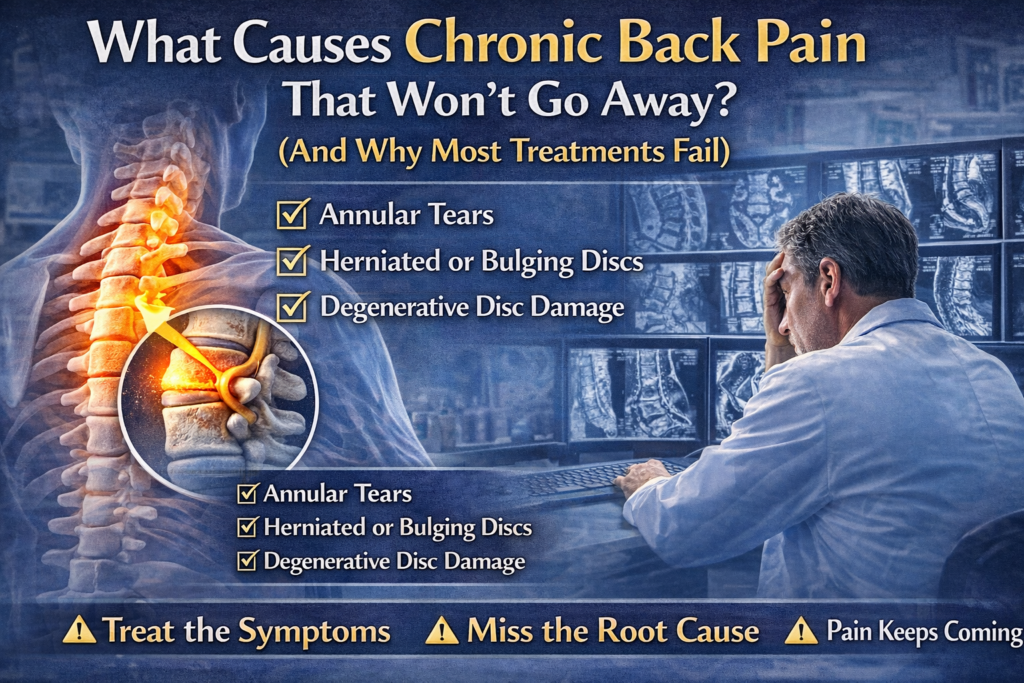
Chronic back pain is one of the most frustrating and misunderstood health conditions people face today. It’s not just discomfort — it’s something that can affect your ability to work, sleep, exercise, and enjoy daily life.
For many patients, the journey looks like this:
You try physical therapy.
You take medications.
You get injections.
You rest, stretch, and modify your lifestyle.
And yet…
👉 The pain keeps coming back.
If you’ve ever asked yourself:
“Why won’t my back pain go away?”
You’re not alone.
The reality is that many chronic back pain cases are not being treated at the root cause. Instead, they are managed at the symptom level — which is why relief is often temporary.
In this guide, we will break down:
• the real causes of chronic back pain
• why many treatments fail
• the hidden role of disc damage
• how nerve irritation develops
• modern approaches to long-term relief
Understanding the true cause of your pain is the first step toward actually fixing it.
What Is Chronic Back Pain?
Chronic back pain is typically defined as:
👉 pain that lasts longer than 12 weeks, even after initial injury or treatment.
Unlike acute pain (which resolves quickly), chronic pain:
• persists over time
• may fluctuate in intensity
• often returns after temporary relief
It can affect:
• the lower back (lumbar spine)
• the upper back (thoracic spine)
• the neck (cervical spine)
The Most Common Causes of Chronic Back Pain
Many patients are told their pain is due to general issues like “wear and tear” or “aging.” While partially true, this explanation often lacks precision.
Below are the most common real causes of chronic back pain.
1. Disc Damage (The Most Overlooked Cause)
Spinal discs are the cushions between your vertebrae.
When these discs become damaged, they can lead to:
• bulging discs
• herniated discs
• degenerative disc disease
• annular tears
👉 Annular tears are especially important.
These small cracks in the outer disc layer:
• leak inflammatory chemicals
• irritate nearby nerves
• create persistent pain
Even when imaging looks “mild,” the pain can be severe.
2. Nerve Compression
When a disc presses on a nerve, it can cause:
• sharp shooting pain
• burning sensations
• tingling
• numbness
Common nerve-related conditions include:
• sciatica
• radiculopathy
• cervical nerve compression
This type of pain often travels:
👉 down the leg (sciatica)
👉 into the arm (cervical spine)
3. Degenerative Disc Disease
As we age, spinal discs lose hydration and elasticity.
This leads to:
• reduced cushioning
• increased friction
• inflammation
Despite the name, it is not a disease — it’s a degenerative process.
However, in some patients, it becomes a major pain generator.
4. Spinal Instability
When the spine loses structural stability, it can lead to:
• abnormal movement
• muscle strain
• nerve irritation
Conditions include:
• spondylolisthesis
• ligament damage
• weakened core support
5. Poor Posture and Lifestyle Factors
Modern lifestyles play a major role in chronic back pain.
Risk factors include:
• prolonged sitting
• poor ergonomics
• lack of exercise
• weak core muscles
These factors increase pressure on spinal discs over time.
6. Previous Injuries That Never Fully Healed
Many patients trace their pain back to:
• a lifting injury
• a sports injury
• a car accident
Even if symptoms improved initially, the underlying damage may remain.
Why Most Back Pain Treatments Fail
This is the most important part.
👉 Most treatments focus on symptoms — not the root cause.
Let’s break it down.
Symptom-Based Treatments
Common approaches include:
Physical Therapy
Helps strengthen muscles
✔ improves mobility
❌ does not repair disc damage
Pain Medications
Reduce inflammation
✔ short-term relief
❌ no structural repair
Steroid Injections
Reduce nerve inflammation
✔ temporary pain relief
❌ does not fix disc tears
👉 Result:
Pain improves temporarily… then returns.
The Missing Piece: Treating the Source of Pain
For many patients, the real issue is:
👉 internal disc damage
Especially:
• annular tears
• disc leakage
• disc instability
If the disc continues to:
• leak inflammatory chemicals
• irritate nerves
Pain will continue — regardless of therapy or medication.
The Pain Cycle Explained
Here’s how chronic back pain often works:
- Disc damage occurs
- Inflammation develops
- Nerves become irritated
- Pain signals increase
- Muscles tighten
- Pressure increases on the disc
👉 Cycle repeats
Unless the source is treated, this loop continues.
Why MRI Results Can Be Misleading
Many patients are told:
👉 “Your MRI doesn’t show anything serious.”
But here’s the truth:
MRIs may miss:
• small annular tears
• internal disc disruption
• chemical inflammation
This creates confusion:
👉 real pain + “normal scan”
Signs Your Back Pain Has a Deeper Cause
If your pain hasn’t gone away, watch for these signs:
• pain lasts more than 3 months
• pain returns after treatment
• sitting makes pain worse
• bending increases pain
• nerve symptoms (tingling, numbness)
• pain spreads to arms or legs
These may indicate disc-related issues.
Modern Approach to Treating Chronic Back Pain
Spine care is evolving.
The focus is shifting from:
❌ removing discs
❌ masking symptoms
To:
✅ repairing discs
✅ restoring structure
✅ reducing inflammation at the source
Why Early Intervention Matters
If left untreated, disc problems can progress:
| Stage | What Happens |
| Early | Annular tears form |
| Mid | Disc bulges or weakens |
| Advanced | Herniation or nerve compression |
| Severe | Chronic pain + mobility loss |
👉 Early treatment = better outcomes
Who Is Most at Risk?
You may be at higher risk if you:
• sit for long periods
• have a desk job
• lift heavy objects
• are physically inactive
• have previous back injuries
• are between ages 25–55
When to See a Specialist
You should seek evaluation if:
• pain persists beyond 6–12 weeks
• treatments haven’t worked
• pain interferes with daily life
• nerve symptoms develop
• mobility decreases
What Real Treatment Should Focus On
An effective long-term solution should:
✔ identify the root cause
✔ reduce inflammation
✔ stabilize the disc
✔ protect surrounding nerves
Preventing Chronic Back Pain
Prevention is key.
Focus on:
• core strengthening
• posture correction
• regular movement
• proper lifting technique
• maintaining healthy weight
Frequently Asked Questions
Why does my back pain keep coming back?
Because the underlying cause — often disc damage — hasn’t been addressed.
Can chronic back pain go away permanently?
Yes, if the root cause is properly treated.
Is surgery always necessary?
No. Many patients can find relief without surgery.
How long should I wait before seeking help?
If pain lasts more than 6–12 weeks, it’s time for evaluation.
Final Thoughts
Chronic back pain is not something you should have to “live with.”
If your pain keeps coming back despite treatment, there is likely a deeper cause that hasn’t been addressed yet.
Understanding the role of disc damage — especially annular tears — is key to finding long-term relief.
Modern spine care is moving toward treating the source of pain, not just the symptoms.
If you are experiencing persistent back or neck pain, the right evaluation can help uncover what’s really going on — and what your best options are moving forward.
