

Back pain is one of the most common reasons people seek medical care—but in many cases, the true cause remains difficult to pinpoint. While herniated discs and spinal stenosis are well known, a lesser-known condition often flies under the radar: annular tears. These small but significant injuries to the spinal disc can cause persistent pain and mobility issues, yet they are frequently misdiagnosed or overlooked.
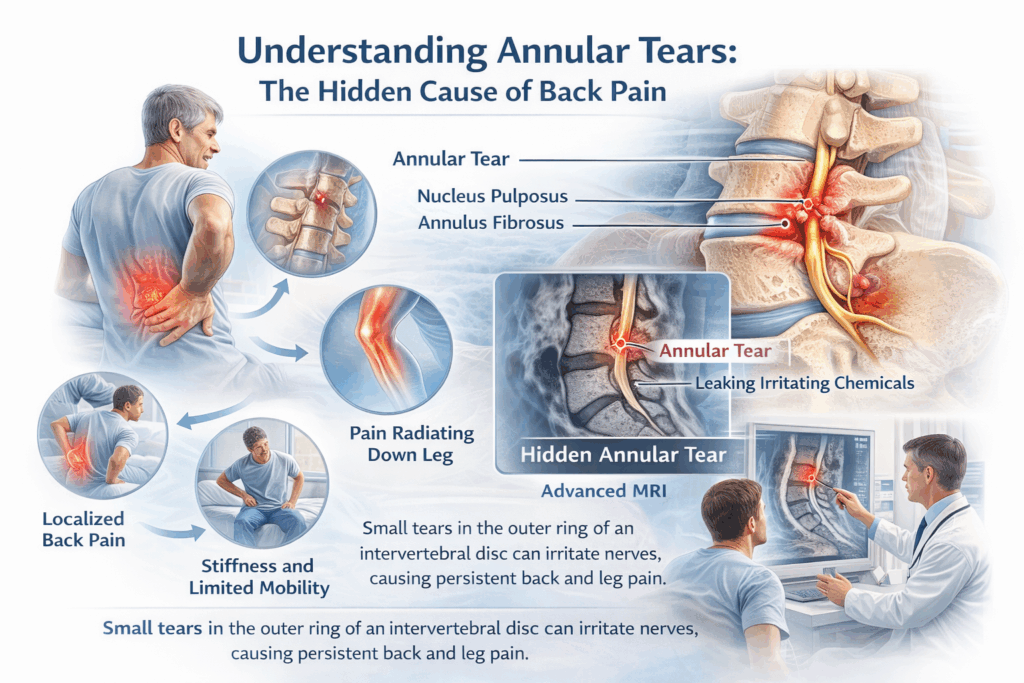
Recognizing annular tear symptoms is critical for proper diagnosis and effective treatment. In this article, we’ll explain what annular tears are, why they cause pain, how symptoms present, and what modern treatment options can help patients find lasting relief.
What Is an Annular Tear?
The spine is made up of vertebrae separated by intervertebral discs that act as shock absorbers. Each disc has two main parts:
- Nucleus pulposus – the soft, gel-like center
- Annulus fibrosus – the tough, fibrous outer ring
An annular tear occurs when small cracks or splits develop in the annulus fibrosus. These tears may result from aging, repetitive stress, sudden injury, or degeneration over time.
While the tear itself may be small, it can cause significant discomfort—especially if inflammatory chemicals leak from the disc or nearby nerve fibers become irritated.
Why Annular Tears Are Often Missed
Annular tears are sometimes called “hidden” injuries because:
- They may not appear clearly on standard imaging
- Symptoms can mimic muscle strain or disc herniation
- Pain may fluctuate or worsen gradually
Many patients are told their imaging looks “normal,” even though they continue to experience pain. Advanced MRI techniques and careful clinical evaluation are often required to identify annular tears accurately.
Common Annular Tear Symptoms
Understanding annular tear symptoms can help patients seek timely care and avoid unnecessary delays in treatment.
1. Localized Back Pain
The most common symptom is persistent pain in the lower back or neck, depending on where the tear is located. The pain is often described as:
- Deep or aching
- Sharp during certain movements
- Worse with sitting, bending, or twisting
Unlike muscle pain, this discomfort tends to persist even after rest.
2. Pain That Worsens with Activity
Activities that increase pressure inside the disc—such as lifting, coughing, or prolonged sitting—can aggravate annular tear symptoms. Many patients report feeling better when lying down and worse when upright.
3. Radiating Pain
If the tear irritates nearby nerve roots, pain may radiate into:
- The buttocks or hips
- One or both legs (similar to sciatica)
- The shoulders or arms (if the tear is in the cervical spine)
This can occur even without a full disc herniation.
4. Stiffness and Limited Mobility
Patients often experience reduced flexibility, particularly in the morning or after periods of inactivity. Movements that involve spinal rotation may feel restricted or painful.
5. Chronic, Unresolved Pain
One hallmark of annular tears is pain that lingers for months despite conservative treatments like rest or basic physical therapy. This ongoing discomfort is often what prompts further evaluation.
What Causes Annular Tears?
Annular tears typically develop due to a combination of factors, including:
- Degenerative disc disease – age-related disc wear
- Repetitive strain – bending, lifting, or twisting motions
- Sudden trauma – falls, accidents, or sports injuries
- Poor posture and prolonged sitting
Over time, the annulus fibrosus becomes less flexible and more prone to tearing under stress.
How Are Annular Tears Diagnosed?
Diagnosing annular tears can be challenging. A comprehensive evaluation usually includes:
- Detailed medical history and symptom review
- Physical and neurological examination
- High-resolution MRI imaging
In some cases, specialized imaging or diagnostic discography may be used to confirm the disc as the source of pain. Accurate diagnosis is essential for creating an effective treatment plan.
Non-Surgical Treatment Options
Many annular tears can heal or become manageable with conservative care. Treatment may include:
- Anti-inflammatory medications
- Targeted physical therapy
- Activity modification
- Epidural steroid injections to reduce inflammation
The goal of non-surgical care is to relieve pain, improve mobility, and support the body’s natural healing process.
When Surgery May Be Considered
If annular tear symptoms persist despite conservative treatment, advanced intervention may be recommended—especially when pain interferes with daily life.
Modern spine care emphasizes minimally invasive approaches, which can:
- Target the damaged disc precisely
- Preserve surrounding muscles and tissue
- Reduce recovery time and post-operative pain
Surgical options depend on the severity of the tear, nerve involvement, and overall spinal health.
Why Proper Treatment Matters
Left untreated, annular tears may worsen or lead to additional disc problems, including herniation. Early diagnosis and appropriate care can:
- Prevent progression of spinal damage
- Reduce chronic pain
- Restore function and quality of life
Understanding annular tear symptoms empowers patients to seek care before the condition becomes more complex.
Find Lasting Relief at Morrison Clinic
Persistent back pain should never be ignored—especially when it disrupts your ability to live comfortably and move freely. Morrison Clinic specializes in identifying and treating complex spine conditions, including annular tears, using advanced diagnostic tools and modern treatment techniques.
At Morrison Clinic, patients benefit from:
- Precise diagnosis of spinal pain sources
- Personalized, patient-centered care plans
- Advanced non-surgical and minimally invasive options
- A focus on long-term relief and functional recovery
If you’re experiencing unresolved back pain or suspect annular tear symptoms may be the cause, expert care can make all the difference. Find lasting relief at Morrison Clinic and take the next step toward a healthier, pain-free spine.
How Modern Spine Surgery Reduces Pain, Risk, and Recovery Time
Spine surgery has changed dramatically over the last two decades. What was once associated with large incisions, extended hospital stays, and months of recovery has evolved into a far more precise, patient-centered field. Thanks to technological innovation, refined surgical techniques, and deeper anatomical understanding, modern spine surgery now focuses on reducing pain, lowering risk, and helping patients return to daily life faster and safer than ever before.
For patients suffering from chronic back or neck pain, nerve compression, or degenerative spine conditions, understanding how today’s spine surgery works can bring clarity—and confidence—when exploring treatment options.
The Shift From Traditional to Modern Spine Surgery
Traditional open spine surgery often required:
- Large incisions
- Significant muscle stripping or retraction
- Higher blood loss
- Longer hospital stays
- Extended recovery and rehabilitation
While effective in many cases, these approaches placed considerable physical stress on the body. Modern spine surgery takes a different path—prioritizing precision over exposure and tissue preservation over disruption.
Today’s techniques aim to treat the source of pain while minimizing impact on surrounding muscles, nerves, and ligaments.
Minimally Invasive Techniques: Less Trauma, Better Outcomes
One of the most significant advancements in modern spine surgery is the widespread use of minimally invasive techniques. These procedures rely on small, targeted incisions and specialized instruments to access the spine with minimal disruption.
How Minimally Invasive Spine Surgery Works
- Small incisions (often less than an inch)
- Muscle fibers are gently separated, not cut
- Tubular retractors or endoscopes create a focused surgical corridor
- High-definition visualization guides precision
By preserving normal anatomy, the body experiences less surgical stress—leading to faster healing and reduced pain.
How Modern Spine Surgery Reduces Pain
Post-operative pain is often caused not just by the spinal condition itself, but by damage to surrounding muscles and soft tissue during surgery. Modern spine surgery significantly limits this damage.
Key pain-reducing factors include:
- Minimal muscle disruption
- Smaller incisions and reduced scarring
- Less inflammation around nerves
- More accurate targeting of the pain source
As a result, many patients require fewer pain medications and experience a smoother recovery process.
Lower Surgical Risk Through Advanced Technology
Modern spine surgery is powered by advanced technology that enhances safety and precision.
Neuronavigation and Real-Time Imaging
Using CT-based navigation systems, surgeons can see a three-dimensional map of the spine during surgery—similar to GPS guidance. This allows for:
- Accurate placement of screws or implants
- Reduced risk of nerve or spinal cord injury
- Greater confidence in complex anatomy
Intraoperative Monitoring
Continuous nerve monitoring tracks neurological signals throughout surgery, alerting the surgical team instantly if nerves are at risk. This adds a critical layer of protection, particularly in delicate procedures.
Robotic-Assisted Precision
In select cases, robotic assistance helps guide instrumentation with sub-millimeter accuracy. This technology improves consistency and reduces human error, especially in multi-level or complex spinal procedures.
Shorter Hospital Stays and Faster Recovery
One of the most meaningful benefits of modern spine surgery is how quickly patients can return to normal activity.
Many patients experience:
- Same-day or next-day discharge
- Walking within hours of surgery
- Earlier return to work and daily routines
- Shortened physical therapy timelines
By minimizing trauma and blood loss, the body can focus its energy on healing rather than repair from extensive surgical disruption.
Targeted Solutions for Complex Spine Conditions
Modern spine surgery allows surgeons to tailor procedures to the specific problem—rather than relying on one-size-fits-all approaches.
Conditions commonly treated include:
- Herniated and degenerative discs
- Spinal stenosis
- Spondylolisthesis
- Annular tears
- Nerve compression and radiculopathy
Precision-focused surgery helps resolve pain at its source while preserving spinal stability and function.
Better Outcomes Through Personalized Planning
No two spines are the same. Modern spine care emphasizes individualized treatment planning, using:
- High-resolution MRI and CT scans
- Dynamic imaging and functional assessments
- Detailed neurological evaluations
This allows surgeons to choose the least invasive, most effective approach for each patient—often avoiding unnecessary surgery altogether.
Reduced Complications and Infection Risk
Smaller incisions and shorter surgical times contribute to:
- Lower infection rates
- Reduced blood loss
- Decreased anesthesia exposure
- Fewer post-operative complications
These benefits are especially important for older adults and patients with underlying medical conditions.
The Importance of Surgical Expertise
Technology alone does not guarantee success. Modern spine surgery requires advanced training, experience, and judgment. Choosing a neurosurgical specialist who routinely performs these procedures is essential for achieving optimal outcomes.
Expert surgeons understand when surgery is appropriate—and when non-surgical care may be more effective.
Who Is a Candidate for Modern Spine Surgery?
Not every patient requires surgery, and not every condition can be treated minimally invasively. Candidates are typically evaluated based on:
- Severity and duration of symptoms
- Failure of conservative treatments
- Imaging findings that correlate with pain
- Overall health and activity goals
A thorough consultation ensures surgery is only recommended when it offers clear benefit.
Why Modern Spine Surgery Focuses on Quality of Life
The ultimate goal of spine surgery is not just correcting anatomy—it’s restoring function, independence, and comfort. Modern approaches prioritize:
- Faster recovery
- Less pain
- Safer procedures
- Long-term durability
Patients can often resume the activities that matter most to them sooner and with greater confidence.
Find Advanced Spine Care at Morrison Clinic
When spine pain interferes with daily life, choosing the right surgical team makes all the difference. Morrison Clinic provides advanced modern spine surgery grounded in precision, technology, and individualized care.
Patients at Morrison Clinic benefit from:
- State-of-the-art minimally invasive techniques
- Advanced imaging and surgical navigation
- Thoughtful, patient-specific treatment plans
- A focus on reducing pain, risk, and recovery time
If you’re exploring spine surgery and want an approach designed around safety, efficiency, and lasting relief, modern spine surgery may be the solution—and Morrison Clinic is equipped to deliver expert care every step of the way.
