

Living with essential tremor can make simple activities unexpectedly difficult. Holding a cup of coffee, signing your name, using a phone, eating with utensils, getting dressed, or performing tasks at work can become frustrating when your hands shake involuntarily.
For some people, tremor remains relatively mild. For others, it progresses until it begins interfering with independence and quality of life.
When medications no longer provide adequate symptom control, patients often begin searching for another option. One of the most common questions is whether essential tremor can be treated without traditional brain surgery.
For appropriately selected patients, the answer may be yes.
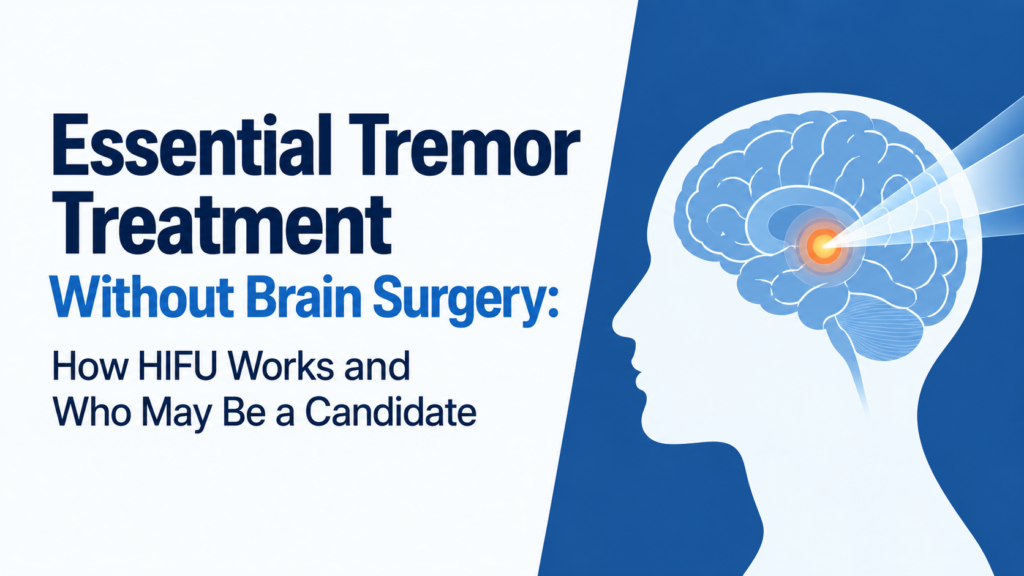
High-Intensity Focused Ultrasound, commonly called HIFU or focused ultrasound, is a non-invasive treatment that uses precisely focused ultrasound energy to target a specific area of the brain associated with tremor. Unlike traditional surgical approaches, HIFU does not require a surgical incision or an implanted device.
Morrison Clinic offers High-Intensity Focused Ultrasound as an advanced treatment option for appropriate patients experiencing essential tremor or tremor associated with Parkinson’s disease.
Understanding how the treatment works, who may qualify, and what patients can expect is an important first step when considering focused ultrasound for tremor.
What Is Essential Tremor?
Essential tremor is a neurological movement disorder that causes involuntary and rhythmic shaking.
It most commonly affects the hands and arms, although tremor may also affect other areas of the body.
The shaking is often most noticeable when a person is trying to perform an activity. This is why everyday tasks such as drinking from a glass, writing, shaving, applying makeup, or eating can become increasingly difficult.
Essential tremor can vary considerably from person to person. Some people experience relatively minor symptoms for years, while others develop tremors that significantly interfere with daily activities.
Although essential tremor is not usually considered life-threatening, its effect on quality of life can be substantial.
Is Essential Tremor the Same as Parkinson’s Disease?
No.
Essential tremor and Parkinson’s disease are different neurological conditions, although both can cause tremor.
Essential tremor commonly becomes noticeable while a person is using their hands or maintaining a posture. Parkinsonian tremor often has different characteristics and may occur when the affected limb is at rest.
Parkinson’s disease can also cause additional symptoms such as stiffness, slowed movement, balance problems, and changes in walking.
Because several neurological conditions can cause shaking, receiving an accurate diagnosis is essential before considering treatment.
A specialist needs to determine what type of tremor you have, how severe it is, and how significantly it is affecting your life.
What Is High-Intensity Focused Ultrasound?
High-Intensity Focused Ultrasound is a non-invasive technology that uses focused ultrasound energy to target a precise location within the brain involved in the abnormal neurological activity responsible for tremor.
You can think of the technology somewhat like focusing sunlight through a magnifying glass. Individual ultrasound waves pass through tissue without creating the desired therapeutic effect on their own. When those waves are precisely focused on the intended target, their combined energy can create a therapeutic effect at that specific location.
The treatment is performed with sophisticated imaging guidance that allows the medical team to identify and monitor the targeted area.
One of the most important differences between HIFU and traditional surgical treatment is that focused ultrasound does not require a surgeon to make a conventional incision into the skull.
There is also no permanent implanted stimulation device.
How Does HIFU Treat Essential Tremor?
Essential tremor is associated with abnormal activity within neurological circuits involved in movement.
Focused ultrasound treatment targets a carefully selected area within those circuits.
Before therapeutic energy is delivered, detailed imaging and treatment planning are used to identify the appropriate target.
Ultrasound energy is then focused on that location.
The treatment team can assess the patient’s response during the procedure and make adjustments as necessary.
The objective is to interrupt the abnormal signals contributing to tremor while minimizing effects on surrounding healthy tissue.
Is HIFU Really Non-Invasive?
Yes. One of the defining characteristics of focused ultrasound is that it is non-invasive.
Traditional brain surgery generally requires an incision and surgical access to structures inside the skull.
Focused ultrasound instead delivers energy through the skull to a precisely selected target.
There is no traditional surgical incision and no implanted hardware.
That distinction is particularly appealing to patients who have significant tremor but are concerned about undergoing conventional brain surgery.
However, non-invasive does not mean that the treatment is appropriate for everyone or that it carries no potential risks.
HIFU is still a specialized neurological treatment that requires careful patient selection and evaluation.
Who May Be a Candidate for HIFU?
Candidacy must be determined individually.
Focused ultrasound may be considered for certain patients whose essential tremor significantly interferes with everyday activities, particularly when medication has not provided adequate control or has caused unacceptable side effects.
During an evaluation, specialists may consider factors such as the type of tremor, its severity, previous treatments, overall health, neurological examination findings, imaging, and other individual medical considerations.
Patients should not assume that experiencing hand tremors automatically makes them candidates for HIFU.
The first step is establishing the correct diagnosis.
When Should You Consider Treatment for Essential Tremor?
Not everyone with essential tremor requires an advanced procedure.
If symptoms are mild and do not interfere with your life, monitoring or medication may be appropriate.
The decision changes when tremor begins limiting important daily activities.
You may want to seek a specialist evaluation if shaking is making it difficult to eat or drink independently, write or sign documents, perform your job, use tools or electronics, participate in hobbies, or complete normal personal care activities.
Another reason to seek an evaluation is when medication is no longer adequately controlling symptoms.
The goal of treatment is not simply to change what a neurological examination looks like. It is to improve the patient’s ability to function and maintain quality of life.
What Are the Potential Advantages of Focused Ultrasound?
The most obvious advantage is the non-invasive nature of the procedure.
HIFU does not require a traditional surgical incision.
It also does not require implantation of a permanent neurological stimulation device.
For appropriate patients, this can provide an important alternative when medication alone is not adequately controlling tremor.
The precise use of imaging and focused energy also allows treatment to be directed toward a carefully selected neurological target.
Recovery considerations may differ significantly from those associated with conventional open surgical procedures.
These advantages are important, but they should always be considered alongside the limitations and potential risks of treatment.
The question should never simply be whether HIFU is the newest technology available.
The more important question is whether it is the right treatment for a particular patient.
HIFU vs. Deep Brain Stimulation
Patients researching advanced essential tremor treatment frequently encounter another procedure called deep brain stimulation, or DBS.
Deep brain stimulation involves surgically implanting electrodes in specific areas of the brain. These electrodes are connected to a device that delivers electrical stimulation to help regulate abnormal neurological signals.
HIFU approaches the problem differently.
Instead of implanting electrodes, focused ultrasound uses energy to create a therapeutic effect at a precisely targeted location.
The two treatments therefore differ substantially in how they are performed.
Which approach is appropriate depends on the individual patient, the nature of the tremor, medical history, treatment goals, and other clinical factors.
A neurosurgical evaluation can help patients understand the advantages, disadvantages, and suitability of available options.
Does HIFU Require General Anesthesia?
Focused ultrasound differs from traditional brain surgery in several important ways, including how patients are monitored during treatment.
Because the treatment team may need to evaluate neurological responses during the procedure, patients can remain interactive during portions of treatment.
Specific anesthesia, sedation, imaging, and procedural protocols vary and should be discussed with the treating medical team.
This interactive component can allow clinicians to assess changes in tremor as treatment progresses.
How Quickly Can HIFU Improve Tremor?
One of the reasons patients are interested in focused ultrasound is that changes in tremor may be observed during or relatively soon after treatment in appropriately selected patients.
However, every patient’s neurological condition and response are different.
No responsible medical provider should promise a specific degree of improvement before completing a thorough evaluation.
Treatment goals should be discussed individually, including which symptoms are most disruptive and what degree of functional improvement would meaningfully improve the patient’s life.
What Are the Risks of Focused Ultrasound?
Although HIFU avoids a traditional surgical incision, it remains a medical procedure and can have risks and side effects.
Potential effects can involve areas such as sensation, balance, walking, coordination, or other neurological functions.
The specific risk profile varies according to the patient and treatment plan.
This is why candidacy assessment is so important.
Patients should have a detailed conversation with their treating specialist about potential benefits, risks, limitations, alternative treatments, and realistic expectations before deciding to proceed.
What Happens During an HIFU Evaluation?
The evaluation begins by confirming the diagnosis and understanding how significantly tremor affects the patient’s life.
Your specialist may review your medical history, neurological symptoms, medications, previous treatment attempts, physical and neurological examination findings, and appropriate imaging.
The team also needs to understand what you hope treatment will accomplish.
For one person, the goal might be being able to eat independently again. For another, it may be returning to professional activities that require fine motor control.
These individual goals matter when evaluating whether treatment is appropriate.
What Questions Should You Ask About HIFU?
Patients considering focused ultrasound should understand exactly why the treatment is or is not being recommended.
Important questions include whether your tremor diagnosis has been confirmed, whether medication options have been adequately explored, whether you meet the criteria for focused ultrasound, what symptoms the procedure is expected to improve, what risks apply to your individual situation, and what alternatives are available.
You should also ask what happens if HIFU is not appropriate for you.
Good neurological care is not about fitting every patient into a particular procedure. It is about determining which treatment best fits the patient.
Why Specialized Evaluation Matters
Tremor can have multiple causes.
Essential tremor, Parkinson’s disease, medication effects, and other neurological disorders can produce symptoms that may appear similar to patients.
Treating tremor effectively therefore begins with understanding why it is occurring.
Advanced technology is most valuable when it is paired with accurate diagnosis, careful patient selection, and individualized treatment planning.
At Morrison Clinic, the approach to neurological and neurosurgical care emphasizes understanding each patient’s condition and discussing appropriate treatment options before proceeding with an intervention.
Morrison Clinic offers High-Intensity Focused Ultrasound for appropriately selected patients with essential tremor and Parkinson’s disease tremors, providing access to a non-invasive option for patients who may otherwise be considering more invasive treatment.
Is HIFU Right for Your Tremor?
There is no single treatment that is right for every person with essential tremor.
Some patients continue to do well with medication.
Others may benefit from focused ultrasound.
Still others may be better candidates for another neurological or neurosurgical treatment.
The decision depends on the diagnosis, severity of symptoms, response to previous treatment, overall medical condition, and the patient’s individual goals.
If your tremor is beginning to interfere with eating, writing, working, hobbies, or other everyday activities, it may be time to have a more detailed conversation about your treatment options.
Take the Next Step
Essential tremor can gradually change the way you perform even the simplest daily activities, but worsening tremor does not mean you have to assume that traditional brain surgery is your only next step.
High-Intensity Focused Ultrasound has created another treatment pathway for appropriately selected patients by allowing specialists to target tremor-related neurological activity without a traditional surgical incision or implanted device.
The most important step is determining whether your symptoms, diagnosis, medical history, and treatment goals make you an appropriate candidate.
Morrison Clinic specializes in advanced neurosurgical care and offers HIFU treatment for appropriate patients with essential tremor and Parkinson’s disease tremors. If tremor is affecting your independence or quality of life, schedule an evaluation with Morrison Clinic to discuss your symptoms and determine which treatment approach may be right for you.
