

Chronic back pain affects millions of people every year, and for many, it becomes more than just an occasional ache. It begins to interfere with work, family life, exercise, sleep, and even simple daily activities. When conservative treatments such as physical therapy, medications, or injections fail to provide lasting relief, many patients begin asking an important question:
Do I really need spine surgery, or is there another option?
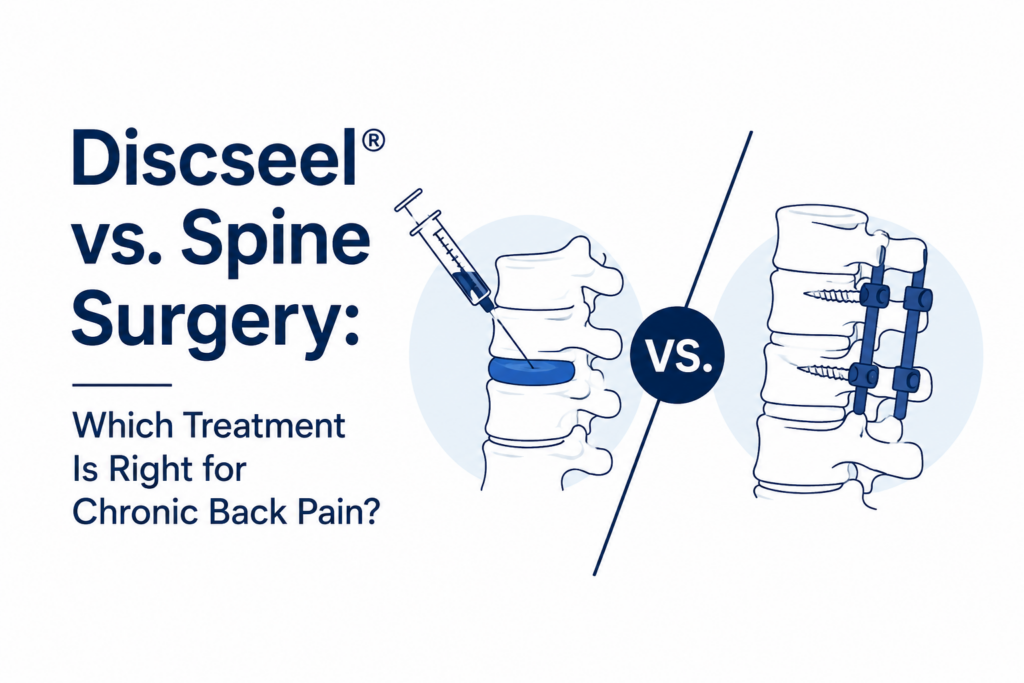
If you’ve been researching treatment options online, you’ve likely come across both Discseel® and traditional spine surgery. While both are designed to help relieve chronic back pain, they work in very different ways and are intended for different types of patients.
Understanding those differences is one of the most important steps you can take before deciding on a treatment plan. Choosing the right approach depends on several factors, including the underlying cause of your pain, the condition of your spinal discs, your overall health, and your long-term goals.
At Morrison Clinic, every patient receives a comprehensive evaluation to determine the most appropriate treatment based on their individual condition. In some cases, minimally invasive treatments such as the Discseel® Procedure may be an option. In others, surgery may still provide the best opportunity for long-term improvement.
This guide explains how both treatments work, who may benefit from each option, and the questions you should ask before making an important decision about your spine health.
What Is Discseel®?
The Discseel® Procedure is a minimally invasive treatment designed to address chronic disc-related back pain in carefully selected patients.
Rather than removing part of the spine or permanently joining vertebrae together, the procedure focuses on helping damaged spinal discs seal small tears that may contribute to ongoing pain. The goal is to preserve as much of the natural anatomy of the spine as possible while addressing a potential source of symptoms.
Unlike traditional open surgery, the Discseel® Procedure is performed through a needle-guided approach using imaging technology to precisely target the affected discs. Because it is minimally invasive, many patients are able to return home the same day.
Not every patient is a candidate, however. A detailed medical history, physical examination, and review of MRI findings are essential to determine whether Discseel® is appropriate.
What Is Traditional Spine Surgery?
Spine surgery is a broad category that includes several different procedures designed to treat structural problems affecting the spine.
Depending on the diagnosis, surgery may involve:
Discectomy
Removal of part of a herniated disc that is pressing on a nerve.
Laminectomy
Removal of a portion of bone or tissue to relieve pressure on the spinal cord or nerves.
Spinal Fusion
Joining two or more vertebrae together to improve spinal stability.
Artificial Disc Replacement
Replacing a damaged spinal disc with an artificial implant in selected patients.
Modern spine surgery has advanced significantly over the past decade. Many procedures are now performed using minimally invasive techniques and robotic-assisted technology, helping reduce tissue disruption and recovery time for appropriate candidates.
For some conditions—such as severe spinal instability, progressive neurological deficits, fractures, tumors, or certain deformities—surgery remains the recommended treatment.
Why Patients Compare Discseel® vs. Spine Surgery
Many people searching for “Discseel vs spine surgery” are not simply looking for the newest procedure. They’re looking for answers after months—or even years—of living with chronic pain.
Common questions include:
- Can I avoid spine surgery?
- Is my herniated disc causing my pain?
- Will my disc heal without surgery?
- Is Discseel® permanent?
- How long is recovery?
- Which option has fewer risks?
- Which treatment is right for someone my age?
These are all reasonable questions, and the answers depend on your specific diagnosis rather than a one-size-fits-all approach.
Understanding the Root Cause of Chronic Back Pain
One of the biggest misconceptions about chronic back pain is that every painful MRI finding automatically requires surgery.
In reality, many adults have age-related changes such as disc bulges or degeneration visible on MRI without experiencing significant symptoms. Conversely, some patients with persistent pain have relatively subtle imaging findings.
That is why a comprehensive evaluation is so important. Your healthcare provider should consider:
- Your symptoms
- Physical examination findings
- MRI or CT imaging
- Neurological function
- Duration of pain
- Previous treatments
- Overall health and activity goals
Only after putting all of these pieces together can an appropriate treatment plan be developed.
Discseel® vs. Spine Surgery: Key Differences
| Feature | Discseel® | Traditional Spine Surgery |
| Approach | Needle-guided, minimally invasive | Procedure depends on diagnosis |
| Goal | Address selected disc-related pain while preserving anatomy | Correct structural problems, relieve nerve compression, or stabilize the spine |
| Hospital Stay | Often outpatient | Varies by procedure |
| Recovery | Generally shorter for appropriate candidates | Depends on the specific surgery |
| Best For | Carefully selected patients with certain disc-related conditions | Patients whose condition requires surgical intervention |
Who May Be a Candidate for Discseel®?
While only a spine specialist can determine candidacy, patients may be evaluated for Discseel® if they have:
- Chronic low back pain that has not improved with conservative care
- MRI findings suggesting certain types of disc-related pathology
- Persistent symptoms despite physical therapy or injections
- A desire to explore minimally invasive treatment options
An evaluation does not guarantee that Discseel® is the right choice. Some patients may ultimately benefit more from another treatment based on their individual condition.
When Spine Surgery May Be the Better Option
Although many patients hope to avoid surgery, there are situations where surgical treatment may be the safest and most effective approach.
Examples can include:
- Significant spinal instability
- Progressive muscle weakness
- Loss of bowel or bladder control requiring emergency evaluation
- Severe spinal stenosis with neurological compromise
- Certain fractures, tumors, or infections
- Conditions where conservative treatment has failed and imaging correlates with symptoms
For these patients, delaying appropriate surgical care may increase the risk of permanent nerve damage or ongoing disability.
Why a Second Opinion Matters
Before making a decision about your spine, consider seeking a comprehensive second opinion.
A thorough evaluation should review:
- Your symptoms
- Previous treatments
- MRI findings
- Functional limitations
- Goals for recovery
Understanding all available treatment options—including conservative care, minimally invasive procedures, and surgery—can help you make a more informed decision.
Questions to Ask During Your Consultation
Before choosing any spine treatment, consider asking:
- What is the exact cause of my pain?
- Do my MRI findings match my symptoms?
- Am I a candidate for minimally invasive treatment?
- What are the expected benefits and limitations of each option?
- What are the risks and recovery expectations?
- What happens if I delay treatment?
These conversations can help clarify whether surgery, Discseel®, or another approach is most appropriate for your situation.
Final Thoughts
Choosing between Discseel® and spine surgery is not about finding a universally “better” treatment—it’s about finding the treatment that best matches your diagnosis, symptoms, and goals.
Some patients are appropriate candidates for minimally invasive procedures such as Discseel®, while others require surgery to address structural spinal conditions or protect neurological function. The most important first step is obtaining an accurate diagnosis and discussing all available options with an experienced spine specialist.
If you’re living with chronic back pain and want to understand what treatment options may be appropriate for your condition, scheduling a comprehensive consultation can help you make an informed decision based on your individual needs rather than assumptions or internet myths.
