

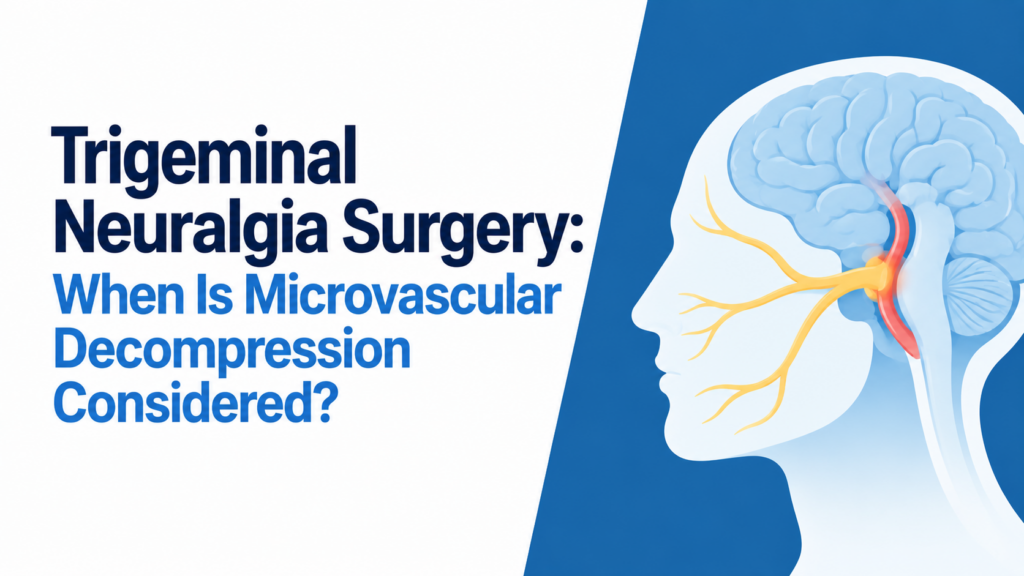
Trigeminal neuralgia can cause some of the most intense facial pain a person can experience. For some patients, ordinary activities such as brushing their teeth, washing their face, eating, speaking, or feeling a light breeze against the skin can trigger sudden episodes of severe pain.
Medication is often the first treatment for trigeminal neuralgia. However, medications do not provide adequate long term symptom control for every patient. Some people continue to experience debilitating attacks despite treatment, while others develop medication related side effects that make continued medical management difficult.
When that happens, patients may begin searching for surgical options and encounter a procedure called microvascular decompression.
Microvascular decompression, commonly abbreviated MVD, is a neurosurgical procedure designed to address certain cases of trigeminal neuralgia in which a blood vessel is compressing or irritating the trigeminal nerve.
For appropriately selected patients, the procedure offers a fundamentally different approach from treatments that primarily manage symptoms. Instead, microvascular decompression attempts to address the underlying neurovascular compression contributing to the facial pain.
Morrison Clinic provides advanced neurosurgical evaluation and treatment for trigeminal neuralgia, including microvascular decompression when clinically appropriate.
Understanding what causes trigeminal neuralgia, how MVD works, and who may be a candidate can help patients make more informed decisions about treatment.
What Is Trigeminal Neuralgia?
Trigeminal neuralgia is a neurological pain condition involving the trigeminal nerve.
The trigeminal nerve is one of the major cranial nerves and carries sensation from the face to the brain. It has three primary branches that provide sensation to areas including the forehead, cheek, jaw, teeth, gums, and portions of the face.
When the nerve becomes irritated or compressed, abnormal pain signals can develop.
Patients often describe trigeminal neuralgia pain as electric, stabbing, shooting, burning, or shock like.
The attacks can be extremely intense even when they last only seconds or minutes.
Some people experience isolated attacks. Others may have repeated episodes over short periods of time.
The unpredictable nature of these attacks can significantly affect everyday life.
What Does Trigeminal Neuralgia Feel Like?
Classic trigeminal neuralgia frequently causes sudden bursts of severe facial pain, usually affecting one side of the face.
The pain may involve the cheek, jaw, teeth, gums, lips, or areas around the nose and eye depending on which branch of the trigeminal nerve is affected.
Certain actions can trigger an attack.
Common triggers may include chewing, talking, brushing the teeth, shaving, washing the face, applying makeup, touching the skin, smiling, or exposure to wind.
This can make patients anxious about performing normal activities because they do not know when another episode will occur.
Some patients also experience periods when attacks become less frequent or temporarily disappear before eventually returning.
Why Does Trigeminal Neuralgia Happen?
In many cases of classic trigeminal neuralgia, a blood vessel is believed to be contacting or compressing the trigeminal nerve near the point where it connects to the brainstem.
Repeated pulsation from the blood vessel may irritate the nerve and affect its protective covering.
This can interfere with normal nerve signaling and contribute to episodes of severe facial pain.
However, not every case of facial pain has the same cause.
Trigeminal neuralgia can sometimes be associated with other neurological conditions, and symptoms resembling trigeminal neuralgia may have entirely different origins.
This is why diagnosis should come before treatment.
How Is Trigeminal Neuralgia Diagnosed?
There is no single symptom that should automatically lead a patient to assume they have trigeminal neuralgia.
Diagnosis generally involves a detailed medical history and neurological evaluation.
The physician will want to understand where the pain occurs, what it feels like, how long attacks last, what triggers them, how frequently they occur, and whether other neurological symptoms are present.
Imaging such as MRI may be used to evaluate the trigeminal nerve and surrounding structures.
Imaging can also help physicians investigate whether a blood vessel may be contacting the nerve and identify other possible causes of facial pain.
The combination of the patient’s symptom pattern, neurological examination, and appropriate imaging helps guide diagnosis and treatment planning.
Can Trigeminal Neuralgia Be Mistaken for Dental Pain?
Yes.
Because trigeminal neuralgia can affect the jaw, gums, teeth, and surrounding areas, patients sometimes initially believe that the problem is dental.
Some may visit a dentist before seeing a neurologist or neurosurgeon.
Dental conditions can certainly cause facial pain, so those possibilities sometimes need to be investigated.
However, repeated electric shock like facial pain triggered by activities such as touching the face, chewing, or brushing the teeth can warrant neurological evaluation, particularly when a dental explanation has not been identified.
Correctly identifying the source of pain is essential before considering any treatment.
What Is the First Treatment for Trigeminal Neuralgia?
Medication is commonly used as an initial treatment.
Certain medications can reduce abnormal nerve signaling and help control attacks.
For some patients, medical management provides meaningful and sustained symptom control.
If medication is effective and well tolerated, surgery may not be necessary.
The situation becomes more complicated when medication stops adequately controlling the pain, higher doses become necessary, or side effects significantly affect quality of life.
At that point, patients may be referred for evaluation of additional treatment options.
When Is Surgery Considered for Trigeminal Neuralgia?
Surgery may be discussed when trigeminal neuralgia remains severe despite appropriate medical treatment or when medications produce unacceptable side effects.
The decision is individualized.
A specialist will consider the characteristics of the facial pain, imaging findings, previous treatment response, age, overall health, and other neurological factors.
One of the most important questions is whether there is evidence that vascular compression of the trigeminal nerve is contributing to the patient’s symptoms.
When neurovascular compression is identified and the patient is otherwise an appropriate surgical candidate, microvascular decompression may be considered.
What Is Microvascular Decompression?
Microvascular decompression is a neurosurgical procedure designed to relieve pressure on a cranial nerve caused by a nearby blood vessel.
In trigeminal neuralgia, the procedure focuses on the trigeminal nerve.
The neurosurgeon accesses the area where the trigeminal nerve connects with the brainstem and carefully identifies blood vessels that may be contacting or compressing the nerve.
The offending vessel can then be repositioned away from the nerve.
A small piece of material may be placed between the vessel and nerve to maintain separation.
The objective is to relieve the physical compression or irritation contributing to abnormal trigeminal nerve signaling.
How Is Microvascular Decompression Different From Other Trigeminal Neuralgia Treatments?
Several procedures may be used to treat trigeminal neuralgia, and they do not all work in the same way.
Some treatments intentionally damage or interrupt portions of the trigeminal nerve to reduce its ability to transmit pain signals.
Microvascular decompression takes a different approach.
Rather than intentionally damaging the trigeminal nerve, MVD aims to separate the nerve from the blood vessel believed to be irritating it.
For patients with classic trigeminal neuralgia caused by vascular compression, this distinction can be important.
However, it also means that microvascular decompression is an intracranial surgical procedure and carries considerations different from less invasive treatments.
Does Microvascular Decompression Require Brain Surgery?
Microvascular decompression is a neurosurgical operation that requires access to the area around the brainstem and cranial nerves.
Although the operation does not involve removing or treating brain tissue in the same manner as surgery for a brain tumor, the surgeon must access structures inside the skull.
A small opening is created to allow the neurosurgeon to reach the trigeminal nerve and surrounding blood vessels.
This is why MVD requires specialized neurosurgical expertise and careful patient selection.
Patients should understand both the potential benefits and risks before choosing the procedure.
Who May Be a Candidate for Microvascular Decompression?
Potential candidates commonly include patients with symptoms consistent with classic trigeminal neuralgia who have not achieved adequate control with medication or cannot tolerate medication related side effects.
Imaging findings may also play an important role.
If MRI or other appropriate imaging demonstrates a blood vessel contacting or compressing the trigeminal nerve, that finding may support consideration of microvascular decompression.
However, imaging alone does not determine candidacy.
A neurosurgeon must evaluate whether the patient’s symptoms, neurological findings, medical history, imaging, and overall health make MVD an appropriate treatment.
Can Microvascular Decompression Cure Trigeminal Neuralgia?
Patients frequently search for a permanent cure for trigeminal neuralgia.
Microvascular decompression is intended to address neurovascular compression rather than simply suppress pain signals. This makes it an important treatment option for appropriately selected patients.
Many patients may experience substantial improvement in facial pain following successful decompression.
However, no responsible surgeon can guarantee that a procedure will permanently eliminate symptoms.
Pain may persist or recur in some patients, and individual outcomes vary.
Patients should discuss expected outcomes and the possibility of recurrence with their neurosurgeon based on their individual case.
What Are the Risks of Microvascular Decompression?
As with any neurosurgical procedure, microvascular decompression carries potential risks.
Possible complications may include bleeding, infection, cerebrospinal fluid leakage, hearing changes, facial numbness, cranial nerve injury, balance problems, anesthesia related complications, stroke, or other neurological complications.
The likelihood and significance of these risks vary according to the patient’s health, anatomy, age, and individual circumstances.
This does not mean that every patient will experience complications.
It means that the decision to undergo MVD should be made after a careful discussion of the expected benefits, alternatives, and individualized risk profile.
How Long Does It Take to Recover From Microvascular Decompression?
Recovery differs from patient to patient.
Because MVD is a neurosurgical procedure, patients generally require a period of postoperative monitoring and recovery.
The length of hospitalization and time required before returning to work, exercise, driving, and other normal activities depends on the individual patient’s progress and the surgeon’s recommendations.
Fatigue and discomfort can occur during the initial recovery period.
Patients should follow postoperative restrictions even if their facial pain improves quickly.
The treating neurosurgical team will provide instructions based on healing and neurological recovery.
Can Trigeminal Neuralgia Come Back After Surgery?
Recurrence is possible.
Although microvascular decompression can provide significant and potentially long lasting relief for appropriately selected patients, trigeminal neuralgia can recur after treatment.
There are several possible reasons.
Changes can occur around the nerve and blood vessels over time, or the underlying pain mechanism may be more complex than initially understood.
If facial pain returns after treatment, patients should undergo another evaluation rather than assuming that the original surgery failed or that the same procedure should automatically be repeated.
What Happens If I Am Not a Candidate for MVD?
Not being a candidate for microvascular decompression does not necessarily mean that no treatment options remain.
Other approaches to trigeminal neuralgia may include continued medical management or different procedures designed to alter the transmission of pain signals through the trigeminal nerve.
The appropriate alternative depends on the patient’s diagnosis, health, previous treatment, and characteristics of the pain.
This is another reason a specialized evaluation is valuable.
The goal is not to make every patient fit the same treatment.
The goal is to determine which treatment strategy is most appropriate for the individual.
When Should Facial Pain Be Evaluated by a Specialist?
Occasional facial discomfort does not automatically indicate trigeminal neuralgia.
However, recurrent episodes of intense, electric shock like facial pain deserve medical evaluation, particularly when they are triggered by touching the face, chewing, talking, or brushing the teeth.
Patients should also seek evaluation when facial pain is persistent, worsening, unexplained, or accompanied by numbness, weakness, vision changes, hearing changes, balance problems, or other neurological symptoms.
Sudden neurological symptoms or unusually severe new symptoms may require urgent medical attention.
Early evaluation can help determine whether the pain is coming from the trigeminal nerve or another condition.
What Questions Should I Ask Before Microvascular Decompression?
Patients considering MVD should understand why the procedure is being recommended.
Ask whether your symptoms are consistent with classic trigeminal neuralgia.
Ask whether imaging shows a blood vessel compressing or contacting the trigeminal nerve.
Ask what medical treatments remain available and why surgery is being considered now.
You should also ask about the surgeon’s treatment goals, expected recovery, potential complications, likelihood of symptom recurrence, and alternatives to MVD.
If you are uncertain about surgery, seeking a second neurosurgical opinion can also help you better understand your options.
Why Neurosurgical Experience Matters
The trigeminal nerve sits in a complex area near the brainstem and other important neurological structures.
Microvascular decompression therefore requires detailed knowledge of cranial nerve anatomy, blood vessels, and microsurgical techniques.
The procedure is not simply about identifying a blood vessel on an MRI.
The surgeon must determine whether the patient’s symptoms and imaging make neurovascular compression a convincing explanation for the pain and whether the potential benefits of surgery justify the risks.
This combination of diagnosis, patient selection, surgical planning, and microsurgical expertise is central to treating trigeminal neuralgia appropriately.
The Morrison Clinic Approach to Trigeminal Neuralgia
Morrison Clinic specializes in advanced neurosurgical care for conditions affecting the brain, spine, cranial nerves, and nervous system.
For patients with trigeminal neuralgia, treatment begins with understanding the characteristics and cause of the facial pain.
When symptoms, imaging, and medical history indicate that a blood vessel may be compressing the trigeminal nerve, microvascular decompression may be considered for appropriately selected patients.
Morrison Clinic’s broader neurosurgical treatment capabilities include care for complex cranial and neurological conditions as well as advanced spine disorders.
The focus is on selecting treatment according to the individual diagnosis rather than recommending surgery simply because a surgical option exists.
Is It Time to Consider Surgery for Trigeminal Neuralgia?
Being diagnosed with trigeminal neuralgia does not automatically mean that you need surgery.
For many patients, medication remains an effective first treatment.
A surgical evaluation becomes more relevant when severe facial pain continues despite appropriate medication, medication side effects become difficult to tolerate, or symptoms significantly interfere with eating, speaking, working, sleeping, and other aspects of everyday life.
Microvascular decompression may provide an important option when neurovascular compression is believed to be responsible for the condition and the patient is an appropriate surgical candidate.
The most important step is determining why the pain is occurring and whether MVD addresses that underlying cause.
If you are experiencing severe or recurrent facial pain, have been diagnosed with trigeminal neuralgia, or are no longer receiving adequate relief from medication, Morrison Clinic can provide a specialized neurosurgical evaluation.
Schedule a consultation with Morrison Clinic to review your symptoms, previous treatments, and imaging and determine whether microvascular decompression or another treatment approach may be appropriate for you.
