

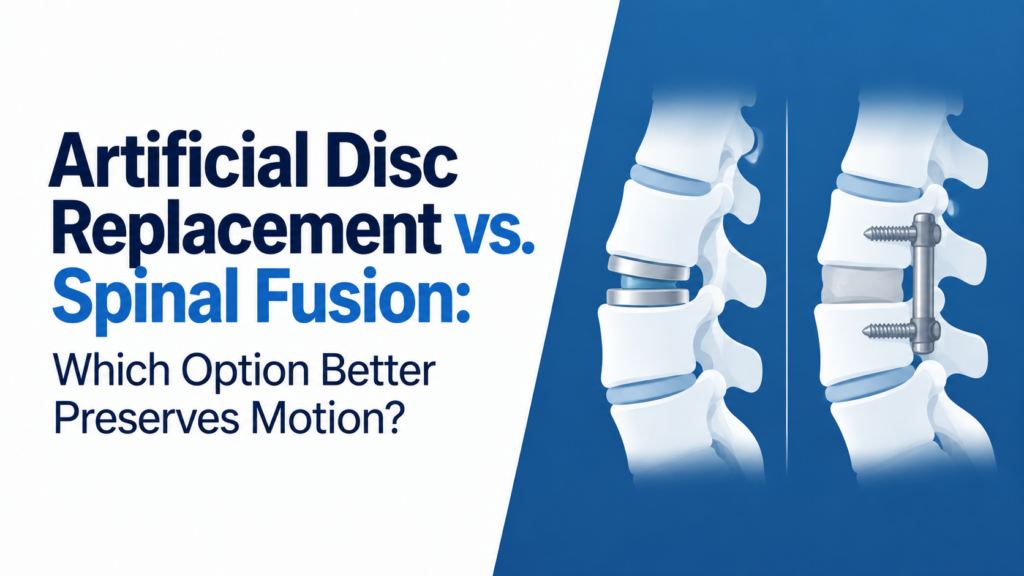
When chronic neck or back pain is caused by a damaged spinal disc and conservative treatment is no longer providing enough relief, patients may begin discussing surgical options with a spine specialist. Two procedures that frequently come up during that conversation are artificial disc replacement and spinal fusion.
Both procedures can be used to treat certain spinal conditions, but they work in fundamentally different ways.
Spinal fusion is designed to permanently stabilize a portion of the spine by joining two or more vertebrae together. Artificial disc replacement, also called total disc replacement, removes a damaged disc and replaces it with an artificial disc designed to maintain movement at that spinal level.
This difference raises an important question for patients: Is artificial disc replacement better than spinal fusion?
There is no universal answer.
For appropriately selected patients, artificial disc replacement may provide an opportunity to treat a damaged disc while preserving motion. For others, spinal fusion may provide the stability necessary to safely address their condition.
At Morrison Clinic, treatment decisions are based on the patient’s diagnosis, symptoms, imaging, spinal stability, anatomy, overall health, and individual goals. Understanding the differences between artificial disc replacement and spinal fusion can help patients have a more informed conversation about which approach may be appropriate.
What Is an Artificial Disc Replacement?
Artificial disc replacement is a surgical procedure in which a damaged or diseased spinal disc is removed and replaced with an artificial implant.
The procedure is also known as total disc replacement or TDR.
Healthy spinal discs sit between the vertebrae and act as cushions while also allowing the spine to bend and move. When a disc becomes significantly damaged, degenerated, or herniated, it may contribute to pain, nerve compression, numbness, weakness, or other neurological symptoms.
During artificial disc replacement, the problematic disc is removed and an artificial disc is positioned between the adjacent vertebrae.
The goal is to address the diseased disc while maintaining movement at that spinal segment.
This is one of the major differences between disc replacement and fusion.
What Is Spinal Fusion?
Spinal fusion is a procedure designed to permanently join two or more vertebrae.
The objective is to eliminate problematic movement at an unstable or painful spinal segment and create a stable structure.
Depending on the procedure, the surgeon may remove damaged disc material, decompress affected nerves, place bone graft material, and use screws, rods, cages, or other spinal implants to provide stability while fusion occurs.
Over time, bone grows between the treated vertebrae so that they heal together as a single unit.
Fusion has been an important treatment for many spinal conditions and remains an appropriate option for numerous patients.
However, because the treated vertebrae are joined together, normal movement at that particular spinal level is reduced or eliminated.
What Is the Main Difference Between Disc Replacement and Fusion?
The fundamental difference is motion.
Spinal fusion intentionally stops movement at the treated spinal level.
Artificial disc replacement attempts to preserve movement.
That distinction can influence how the spine functions after surgery and is one reason motion preservation has become an important area of modern spine care.
However, preserving motion is only beneficial when doing so is safe and appropriate.
If a spinal segment is significantly unstable, structurally compromised, or affected by another condition that makes movement problematic, fusion may be the more appropriate treatment.
The objective should never be to preserve motion at all costs.
The objective is to choose the surgical strategy that best addresses the underlying problem.
Why Does Preserving Spinal Motion Matter?
The spine is designed to move.
Individual spinal segments work together to allow bending, rotation, extension, and other normal movements.
When one segment is fused, movement at that level is intentionally eliminated. Other spinal levels continue to move and may compensate for the lost motion.
This has led spine specialists to investigate procedures that can address certain spinal problems while preserving more natural movement.
Artificial disc replacement is one such option.
By replacing the damaged disc with a mobile artificial implant, the goal is to maintain movement at the treated level rather than permanently immobilizing it.
For an appropriate patient, maintaining motion may help preserve more natural spinal mechanics.
What Conditions Can Artificial Disc Replacement Treat?
Artificial disc replacement may be considered for selected patients with cervical or lumbar disc disease.
Potential candidates may have conditions such as degenerative disc disease, certain herniated discs, disc related neck or back pain, or neurological symptoms caused by a damaged spinal disc.
Patients may experience neck pain, back pain, pain traveling into an arm or leg, numbness, tingling, or weakness depending on the location and severity of the problem.
However, simply having a damaged disc on an MRI does not mean that disc replacement is appropriate.
Many adults have degenerative changes on imaging without experiencing significant symptoms.
The physician must determine whether the abnormal disc is actually responsible for the patient’s pain or neurological symptoms.
Is Artificial Disc Replacement Available for Both the Neck and Lower Back?
Artificial disc replacement can be performed in selected areas of both the cervical spine and lumbar spine.
Cervical disc replacement involves the neck.
Lumbar disc replacement involves the lower back.
The anatomy, biomechanics, implants, surgical approach, and patient selection considerations differ between these regions.
A patient who is a good candidate for cervical disc replacement is not automatically a good candidate for lumbar disc replacement.
Each case requires individual evaluation.
Who May Be a Good Candidate for Artificial Disc Replacement?
Patient selection is one of the most important factors in artificial disc replacement.
Potential candidates may have a clearly identified damaged disc that corresponds with their symptoms and may have already attempted appropriate conservative treatments without sufficient improvement.
The spine must also have characteristics that make motion preservation reasonable.
Factors such as spinal instability, severe facet joint disease, significant deformity, osteoporosis, fractures, previous procedures, anatomy, and the number of affected spinal levels may influence whether disc replacement is appropriate.
Age and overall health may also be considered.
This is why the decision cannot be made solely by looking at a single MRI image.
A comprehensive clinical evaluation is necessary.
Who May Need Spinal Fusion Instead?
Fusion may be preferable when stability is the primary concern.
Certain patients with spinal instability, significant spondylolisthesis, severe deformity, fractures, advanced degeneration, or other structural problems may require fusion.
Fusion can also be necessary when enough bone, disc, or supporting tissue must be removed during decompression that the spinal segment would otherwise become unstable.
Some revision surgeries and complex spinal conditions may also require fusion.
In these situations, maintaining movement at the affected level may not be safe or beneficial.
The stability provided by fusion can be an essential part of treatment.
Is Artificial Disc Replacement Better Than Fusion for a Herniated Disc?
It depends on the patient and the characteristics of the herniated disc.
Many herniated discs never require either procedure.
Symptoms can improve with conservative treatment, and some herniations may decrease in size over time.
When surgery becomes necessary, some patients may only require decompression or removal of the problematic portion of the disc.
Others may have more extensive disc damage that leads to consideration of disc replacement or fusion.
If the disc needs to be removed and the patient has appropriate anatomy and spinal stability, artificial disc replacement may be considered as a motion preserving alternative to fusion.
If instability or other structural problems are present, fusion may be more appropriate.
Does Artificial Disc Replacement Prevent Adjacent Segment Disease?
Patients researching fusion often encounter the term adjacent segment disease.
After a spinal segment is fused, neighboring levels continue to move. Changes in the mechanics of the spine may place different stresses on adjacent segments.
Over time, some patients can develop degeneration at levels next to a fusion.
Artificial disc replacement was developed in part to maintain movement at the treated level and potentially reduce some of the biomechanical changes associated with fusion.
However, no procedure can guarantee that future degeneration will not occur.
Spinal discs naturally change with age, and multiple factors contribute to degeneration.
Motion preservation may offer biomechanical advantages in appropriately selected patients, but patients should discuss long term expectations with their surgeon rather than viewing disc replacement as a guarantee against future spinal problems.
What Is Spinal Motion Preservation?
Spinal motion preservation refers to a broader treatment philosophy aimed at addressing spinal disease while maintaining as much healthy movement as safely possible.
Artificial disc replacement is one example.
Other surgical strategies may also seek to decompress nerves or address spinal pathology without automatically fusing the affected segment.
Morrison Clinic offers spinal motion preservation and total disc replacement as part of its advanced spine treatment options for appropriately selected patients.
The underlying principle is straightforward.
If a spinal problem can be effectively treated while safely maintaining movement, preserving that movement may be beneficial.
But when stability is compromised, fusion may still be the better solution.
What Are the Potential Benefits of Artificial Disc Replacement?
The primary potential benefit is preservation of motion at the treated spinal level.
This may allow the spine to maintain more natural movement compared with fusion.
Because the procedure does not rely on two vertebrae permanently growing together, recovery considerations can also differ from fusion.
Disc replacement may potentially reduce some of the mechanical stress transferred to neighboring levels, although long term outcomes depend on many individual factors.
For appropriate patients, artificial disc replacement provides another option between continuing ineffective conservative treatment and permanently fusing a spinal segment.
These potential advantages should be considered alongside the procedure’s risks, limitations, and strict candidacy requirements.
What Are the Potential Benefits of Spinal Fusion?
The major benefit of spinal fusion is stability.
If abnormal movement between vertebrae is contributing to pain, deformity, or neurological problems, permanently stabilizing the segment may be necessary.
Fusion also allows surgeons to address conditions where maintaining movement would be undesirable or unsafe.
Modern fusion procedures may incorporate minimally invasive techniques, advanced imaging, navigation, and robotic guidance to improve surgical planning and execution in appropriate cases.
Therefore, the comparison should not be framed as new technology versus old technology.
Disc replacement and fusion solve different biomechanical problems.
What Is Recovery Like After Artificial Disc Replacement?
Recovery varies depending on whether the procedure involves the cervical or lumbar spine, the patient’s overall health, the number of levels treated, and other individual factors.
Because artificial disc replacement does not depend on creating a permanent bone fusion between the vertebrae, the healing process differs from traditional fusion.
Patients still need to follow postoperative restrictions and gradually return to normal activities according to their surgeon’s recommendations.
A motion preserving procedure is still spine surgery.
Patients should not assume that an artificial disc means there will be no postoperative discomfort or recovery period.
How Long Does Spinal Fusion Take to Heal?
Fusion requires biological healing.
Bone must gradually grow between the treated vertebrae and develop into a solid fusion.
This process can take months.
Patients may return to various activities before the fusion is completely mature, but the timeline depends on the operation, spinal level, health, lifestyle, and healing progress.
Smoking, bone health, nutrition, certain medical conditions, and other factors can influence bone healing.
Patients undergoing fusion should follow their surgeon’s restrictions carefully while the spine heals.
Are Artificial Discs Safe?
Artificial disc replacement is an established treatment option for appropriately selected patients.
As with any surgical procedure, however, there are potential risks.
These may include infection, bleeding, nerve injury, implant related complications, persistent symptoms, abnormal bone formation, movement of the implant, or the need for additional surgery.
The exact risk profile depends on the patient’s condition, the spinal level being treated, the implant, anatomy, and other individual considerations.
Patients should discuss both short term and long term risks with their surgeon.
Does Morrison Clinic Use Motion Preserving Spine Technology?
Morrison Clinic provides advanced spine surgery options that include spinal motion preservation and total disc replacement for appropriately selected patients.
The clinic’s treatment philosophy emphasizes matching the surgical approach to the individual condition rather than automatically performing the same procedure for every patient.
Morrison Clinic also provides minimally invasive spine surgery, endoscopic spine surgery, robotic spine surgery, spinal fusion, Discseel®, and other advanced treatment options depending on the patient’s diagnosis.
For artificial disc replacement and motion preservation procedures, Morrison Clinic utilizes modern spinal implant technology, including options from Centinel Spine when clinically appropriate.
The specific implant and procedure should always be selected based on the patient’s anatomy and treatment needs.
Should I Get a Second Opinion Before Spinal Fusion?
If you have been told that you need a spinal fusion, seeking a second opinion can be reasonable, particularly when the procedure is elective and you want to understand whether alternatives exist.
A second opinion does not necessarily mean the original recommendation was incorrect.
It provides another opportunity to confirm the diagnosis and ask whether fusion is necessary.
Questions may include whether a minimally invasive procedure could address the problem, whether endoscopic decompression is possible, whether motion can safely be preserved, or whether artificial disc replacement is an option.
For some patients, the second opinion may confirm that fusion is the best approach.
For others, another treatment option may be identified.
What Questions Should I Ask My Spine Surgeon?
Before deciding between artificial disc replacement and fusion, make sure you understand exactly what is causing your symptoms.
Ask whether the damaged disc seen on imaging corresponds with your pain or neurological symptoms.
Ask whether surgery is necessary now or whether conservative treatment remains appropriate.
If fusion has been recommended, ask why the spinal segment needs to be immobilized.
If artificial disc replacement is being considered, ask why you are a good candidate for preserving motion.
You should also understand the expected recovery, potential risks, limitations, long term considerations, and possibility of future treatment.
The best surgical decision is an informed one.
Artificial Disc Replacement vs. Fusion: Which Is Right for You?
There is no procedure that is universally better.
Artificial disc replacement may offer an important motion preserving alternative for patients with suitable anatomy, spinal stability, and disc related disease.
Spinal fusion may be the more appropriate choice when instability, deformity, advanced degeneration, or another structural problem requires permanent stabilization.
Some patients may not need either procedure.
They may be candidates for endoscopic decompression, minimally invasive surgery, Discseel®, continued conservative treatment, or another approach.
This is why the diagnosis must drive the treatment.
At Morrison Clinic, advanced spine care includes total disc replacement, spinal motion preservation, spinal fusion, minimally invasive spine surgery, endoscopic spine surgery, robotic spine surgery, and non surgical options such as the Discseel® Procedure for appropriately selected patients.
The goal is not simply to avoid fusion or choose the newest technology. It is to determine which treatment can address the underlying spinal problem safely while preserving healthy anatomy and function whenever appropriate.
If chronic neck pain, back pain, a herniated disc, degenerative disc disease, or nerve symptoms are affecting your quality of life, or if you have already been told that you need spinal fusion, schedule a consultation with Morrison Clinic.
A comprehensive evaluation of your symptoms, neurological findings, medical history, and imaging can help determine whether artificial disc replacement, spinal fusion, a motion preserving procedure, or another treatment option may be appropriate for you.
