
Can a Herniated Disc Heal Without Surgery?
One of the first questions patients ask after being diagnosed with a herniated disc is:
“Will I need surgery?”
Closely followed by:
“Can a herniated disc heal on its own?”
The answer may surprise many patients.
In numerous cases, the answer is yes.
Many herniated discs improve without surgery, and some even shrink naturally over time. However, the ability of a disc to heal depends on several factors, including the severity of the injury, the location of the herniation, the patient’s overall health, lifestyle habits, and whether nerve compression is involved.
For patients throughout New York City and Connecticut, understanding how herniated discs heal can help eliminate fear, improve treatment decisions, and prevent unnecessary procedures.
Modern spine care in 2026 focuses heavily on understanding which patients can benefit from conservative treatment and which patients require more aggressive intervention.
The goal is not simply avoiding surgery.
The goal is choosing the treatment approach that provides the best long term outcome.
What Is a Herniated Disc?
The spine contains discs located between each vertebra.
These discs function as shock absorbers and help support movement throughout the body.
Each disc contains:
• A soft inner center called the nucleus pulposus
• A tougher outer layer called the annulus fibrosus
A herniated disc occurs when the inner disc material pushes through a weakened or damaged area of the outer layer.
This may cause:
• Inflammation
• Nerve irritation
• Sciatica
• Back pain
• Neck pain
• Weakness
• Tingling
• Numbness
Some herniations are small and relatively stable.
Others are larger and may significantly impact nearby nerves.
How Common Are Herniated Discs?
Herniated discs are extremely common.
Millions of adults experience disc related symptoms every year.
Many people develop disc abnormalities without realizing it.
In fact, imaging studies frequently reveal herniated discs in individuals who have little or no pain.
This highlights an important principle in spine care:
Not every herniated disc requires surgery.
Not every herniated disc even causes symptoms.
Treatment decisions must always be based on the complete clinical picture.
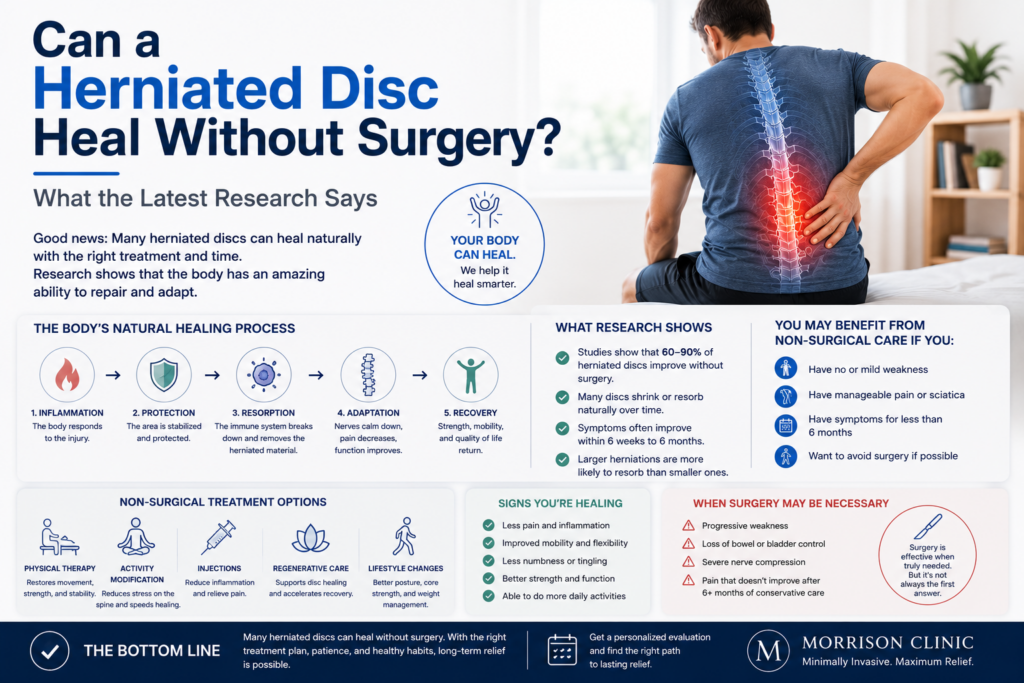
The Body’s Natural Healing Process
One of the most fascinating aspects of spine medicine is the body’s ability to adapt and heal.
When a herniated disc develops, the body often initiates several natural healing responses.
These include:
• Reducing inflammation
• Removing damaged tissue
• Reabsorbing disc material
• Stabilizing affected structures
• Adapting to structural changes
These processes may occur gradually over weeks or months.
In some cases, significant improvement occurs without surgery.
Can Herniated Discs Actually Shrink?
Research over the past two decades has demonstrated that certain herniated discs can decrease in size naturally.
This process is known as spontaneous resorption.
During resorption:
• The immune system recognizes displaced disc material
• Inflammatory cells help break down damaged tissue
• The body gradually removes portions of the herniation
• Pressure on nerves may decrease
As this process occurs, symptoms often improve.
Some studies have found that larger herniations may actually be more likely to undergo resorption than smaller protrusions because the body can more easily recognize and remove the displaced material.
Why Some Patients Improve Without Surgery
Several factors contribute to non surgical recovery.
Reduction of Inflammation
Inflammation is often responsible for a significant portion of disc related pain.
As inflammation decreases, symptoms frequently improve.
Decreased Nerve Irritation
When pressure and inflammation around nerves lessen, nerve symptoms often become less severe.
Improved Movement Patterns
Many patients unknowingly place excessive stress on injured discs.
Improving posture, mobility, and biomechanics may reduce irritation.
Natural Tissue Adaptation
The body often adapts to structural abnormalities over time, allowing patients to function more comfortably.
How Long Does Recovery Take?
Recovery timelines vary significantly.
Some patients improve within a few weeks.
Others require several months.
Factors influencing recovery include:
• Severity of herniation
• Degree of inflammation
• Nerve involvement
• Overall health
• Activity level
• Compliance with treatment
• Lifestyle habits
Patients should understand that healing is rarely linear.
Improvement often occurs gradually with occasional flare ups along the way.
Signs Your Herniated Disc May Be Improving
Positive signs may include:
• Reduced leg pain
• Less numbness
• Improved mobility
• Increased sitting tolerance
• Better sleep quality
• Improved walking ability
• Reduced reliance on medication
These improvements often indicate that inflammation and nerve irritation are decreasing.
Why Sitting Often Delays Recovery
Patients throughout New York City frequently spend long hours:
• Commuting
• Working at desks
• Traveling
• Attending meetings
Unfortunately, sitting places increased pressure on spinal discs.
This added pressure may:
• Aggravate herniations
• Increase inflammation
• Delay recovery
• Trigger symptom flare ups
Many patients notice that standing and walking provide relief while sitting worsens symptoms.
Why Sciatica Often Accompanies Herniated Discs
Sciatica develops when herniated discs irritate nearby nerve roots.
Common symptoms include:
• Leg pain
• Burning sensations
• Tingling
• Numbness
• Weakness
• Electric shock sensations
As the disc heals and inflammation decreases, sciatic symptoms often improve as well.
However, persistent nerve compression may require more aggressive treatment.
Non Surgical Treatment Options
Modern spine care offers numerous non surgical treatment approaches.
These may include:
• Physical therapy
• Core strengthening
• Postural correction
• Activity modification
• Image guided injections
• Anti inflammatory treatment
• Regenerative medicine approaches
• Lifestyle optimization
The goal is supporting the body’s healing process while minimizing ongoing irritation.
Why Physical Therapy Matters
Physical therapy remains one of the most important components of recovery.
Proper rehabilitation may help:
• Improve spinal stability
• Reduce mechanical stress
• Strengthen supporting muscles
• Improve mobility
• Enhance posture
• Prevent recurrence
However, programs should be individualized based on the patient’s condition and symptoms.
The Role of Core Strength
Weak core muscles increase stress on spinal structures.
Improving core stability may help:
• Support the spine
• Improve alignment
• Reduce disc loading
• Minimize recurrence risk
Core strength is often a critical component of long term recovery.
Why Some Herniated Discs Do Not Heal Well
Although many patients improve conservatively, some cases remain problematic.
Factors that may limit healing include:
• Severe nerve compression
• Significant degeneration
• Ongoing mechanical stress
• Poor lifestyle habits
• Smoking
• Obesity
• Chronic inflammation
• Spinal instability
These situations may require additional treatment beyond conservative care.
When Surgery May Be Necessary
Despite advances in non surgical treatment, surgery remains appropriate for certain patients.
Potential indications include:
• Progressive weakness
• Severe neurological deficits
• Loss of bowel or bladder control
• Significant spinal cord compression
• Persistent disabling symptoms despite treatment
These situations should be evaluated carefully by a qualified spine specialist.
Why Surgery Is Not Always the Best First Option
Many patients assume surgery offers the fastest solution.
However, surgery carries potential risks including:
• Infection
• Scar tissue formation
• Recurrent disc herniation
• Persistent pain
• Adjacent segment degeneration
• Recovery time
When conservative treatment has a reasonable chance of success, many specialists prefer exploring those options first.
Lifestyle Habits That Support Recovery
Patients can significantly improve recovery potential through healthy daily habits.
Important strategies include:
• Staying active
• Walking regularly
• Improving posture
• Maintaining healthy body weight
• Avoiding smoking
• Managing stress
• Prioritizing sleep
• Reducing prolonged sitting
Small daily improvements often create significant long term benefits.
Questions Patients Should Ask
Patients diagnosed with a herniated disc should ask:
• Is surgery truly necessary?
• What are my non surgical options?
• How severe is my herniation?
• Is nerve damage present?
• What activities should I avoid?
• What is my likelihood of recovery without surgery?
• How can I prevent recurrence?
These questions help patients make informed treatment decisions.
Why Accurate Diagnosis Matters
Not every MRI finding explains symptoms.
Successful treatment depends on understanding:
• Which disc is involved
• Whether nerves are compressed
• How much inflammation is present
• Whether instability exists
• What factors are aggravating symptoms
Accurate diagnosis often determines whether conservative treatment is likely to succeed.
Conclusion
The latest research continues to demonstrate that many herniated discs can improve without surgery.
Through a combination of natural healing, reduced inflammation, improved movement mechanics, and modern non surgical treatment approaches, many patients experience significant recovery while avoiding invasive procedures.
For patients in New York City and Connecticut dealing with disc related pain, the most important step is obtaining an accurate diagnosis and understanding all available treatment options before making major decisions.
Surgery can be extremely effective when truly necessary, but many patients may discover that their body is capable of far more healing than they initially believed.
