

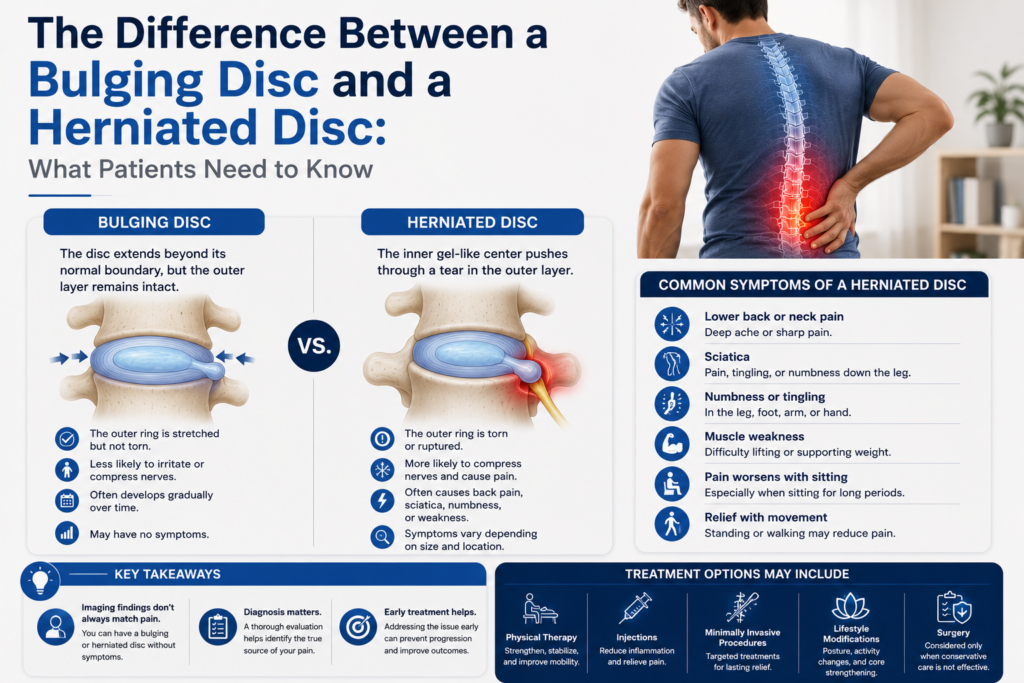
Bulging Disc vs Herniated Disc: Understanding the Difference
One of the most common questions patients ask after receiving an MRI report is:
“Do I have a bulging disc or a herniated disc?”
Many people assume these terms mean the same thing. Others believe a bulging disc is simply a mild version of a herniated disc. While the two conditions are related, they are not identical.
Understanding the difference is important because treatment recommendations, recovery expectations, and long term outcomes can vary significantly depending on the type and severity of disc injury.
For patients throughout New York City and Connecticut, MRI reports frequently mention disc abnormalities. Unfortunately, many patients leave appointments with more questions than answers.
They often wonder:
• Is my condition serious?
• Will I need surgery?
• Why am I in pain?
• Can this heal naturally?
• What treatment options are available?
The answers begin with understanding exactly what a spinal disc is and how disc injuries develop.
Understanding How Spinal Discs Work
The spine is made up of vertebrae stacked on top of one another.
Between each vertebra sits a spinal disc.
Discs serve several critical functions:
• Shock absorption
• Load distribution
• Flexibility
• Movement support
• Protection of spinal structures
Each disc consists of two primary parts.
The center contains a soft gel like material called the nucleus pulposus.
Surrounding this center is a stronger outer layer called the annulus fibrosus.
Together, these structures help the spine withstand daily stress from:
• Walking
• Sitting
• Lifting
• Twisting
• Bending
• Physical activity
Over time, however, discs may become damaged through injury, degeneration, repetitive stress, or aging.
What Is a Bulging Disc?
A bulging disc occurs when the outer portion of the disc extends beyond its normal boundaries.
Think of it as a tire that begins to bulge outward without actually rupturing.
The disc remains intact.
The outer fibers remain largely contained.
However, the disc begins protruding beyond its normal position.
Bulging discs often develop gradually.
Common contributing factors include:
• Aging
• Disc degeneration
• Repetitive spinal stress
• Poor posture
• Prolonged sitting
• Occupational strain
Many adults develop some degree of disc bulging as they age.
In fact, bulging discs are frequently found in patients who have no symptoms at all.
What Is a Herniated Disc?
A herniated disc occurs when the inner disc material pushes through a damaged portion of the outer disc layer.
Unlike a bulging disc, the outer annulus has developed a tear or weakness.
This allows disc material to extend outward.
As a result, herniated discs are more likely to:
• Compress nerves
• Trigger inflammation
• Cause sciatica
• Produce neurological symptoms
• Create severe pain
While bulging discs typically involve generalized disc expansion, herniations involve a more focal area of damage.
How Disc Herniations Develop
Most herniated discs do not occur overnight.
They often develop through a gradual process.
The progression may include:
• Disc degeneration
• Annular weakening
• Annular tears
• Bulging
• Herniation
This means that some herniated discs begin as bulging discs before progressing further.
However, not every bulging disc becomes a herniation.
Common Symptoms of a Bulging Disc
Many bulging discs cause no symptoms whatsoever.
When symptoms do occur, they may include:
• Localized back pain
• Stiffness
• Reduced mobility
• Mild discomfort during activity
• Occasional flare ups
Symptoms depend on:
• Disc location
• Degree of bulging
• Presence of inflammation
• Whether nearby nerves are affected
Some patients discover they have bulging discs only after undergoing imaging for unrelated reasons.
Common Symptoms of a Herniated Disc
Herniated discs are more likely to produce noticeable symptoms.
These may include:
• Sharp pain
• Sciatica
• Burning sensations
• Tingling
• Numbness
• Muscle weakness
• Pain radiating into the arms or legs
• Difficulty sitting
• Pain during movement
Because herniated discs frequently irritate nearby nerves, symptoms often extend beyond the spine itself.
Why MRI Reports Create Confusion
One reason patients become confused is that MRI terminology can vary.
Reports may include phrases such as:
• Disc bulge
• Disc protrusion
• Disc extrusion
• Disc herniation
• Disc degeneration
• Annular fissure
Many patients assume every abnormality is serious.
Others assume mild findings cannot possibly explain severe symptoms.
The truth is more complicated.
MRI findings must always be interpreted alongside:
• Symptoms
• Physical examination
• Neurological testing
• Functional limitations
An MRI alone rarely tells the complete story.
Why Some Bulging Discs Cause Severe Pain
Many patients are surprised to learn that relatively small abnormalities can create significant symptoms.
Pain is influenced by:
• Inflammation
• Nerve sensitivity
• Mechanical stress
• Disc pressure
• Annular tears
• Biomechanical dysfunction
A patient with a mild bulging disc and significant inflammation may experience more pain than someone with a larger herniation and little inflammation.
This is why imaging findings do not always predict symptom severity.
The Role of Annular Tears
One often overlooked contributor to disc pain is the annular tear.
An annular tear develops when small cracks form in the outer portion of the disc.
These tears may:
• Trigger inflammation
• Increase disc sensitivity
• Cause chronic pain
• Lead to herniation
Many patients with annular tears experience severe symptoms despite relatively modest MRI findings.
This is one reason accurate diagnosis is so important.
Why Sitting Often Makes Disc Pain Worse
Patients in New York City frequently report worsening symptoms while sitting.
Common triggers include:
• Office work
• Commuting
• Driving
• Flying
• Remote work
Sitting increases pressure inside spinal discs.
This added pressure may aggravate:
• Bulging discs
• Herniated discs
• Annular tears
• Nerve irritation
Many patients experience significant relief simply by standing and walking.
Can Bulging Discs Heal Naturally?
Bulging discs may remain stable for years.
In some cases, symptoms improve through:
• Reduced inflammation
• Improved posture
• Rehabilitation
• Lifestyle changes
• Strengthening programs
The disc itself may not completely return to its previous shape, but symptoms often improve substantially.
Can Herniated Discs Heal Naturally?
Many herniated discs improve without surgery.
The body may gradually:
• Reduce inflammation
• Reabsorb disc material
• Adapt to structural changes
Research has shown that some herniations shrink naturally over time.
However, recovery varies significantly depending on:
• Severity
• Location
• Nerve involvement
• Overall spinal health
Treatment Options for Bulging and Herniated Discs
Treatment depends on the specific diagnosis and symptom severity.
Common approaches include:
• Physical therapy
• Core strengthening
• Postural correction
• Activity modification
• Anti inflammatory treatment
• Image guided procedures
• Regenerative medicine approaches
• Minimally invasive interventions
The goal is addressing the underlying cause rather than simply masking symptoms.
When Surgery May Be Necessary
Most bulging discs do not require surgery.
Many herniated discs do not require surgery either.
However, surgical intervention may be appropriate when patients experience:
• Progressive weakness
• Severe nerve compression
• Loss of bowel or bladder control
• Significant functional decline
• Persistent disabling symptoms
The decision should always be based on the complete clinical picture rather than MRI findings alone.
Questions Patients Should Ask After an MRI
After receiving MRI results, patients should ask:
• Is my disc bulging or herniated?
• Is the abnormality causing my symptoms?
• Is nerve compression present?
• Are annular tears involved?
• What treatment options exist?
• Can this improve without surgery?
• What lifestyle changes may help?
These questions often lead to more meaningful discussions and better treatment decisions.
Why Accurate Diagnosis Matters
Many patients spend months pursuing treatment without fully understanding what their MRI findings actually mean.
The difference between a bulging disc and a herniated disc can significantly influence:
• Treatment planning
• Recovery expectations
• Risk of recurrence
• Long term management strategies
Accurate diagnosis helps ensure patients receive the most appropriate care for their specific condition.
Conclusion
Bulging discs and herniated discs are related but distinct conditions.
A bulging disc occurs when the disc extends beyond its normal boundaries while remaining largely intact.
A herniated disc occurs when inner disc material pushes through damaged outer fibers.
Although herniated discs are generally more likely to irritate nerves and produce significant symptoms, both conditions can contribute to chronic pain depending on the individual patient.
For patients in New York City and Connecticut dealing with back pain, sciatica, or confusing MRI results, understanding the difference between these two conditions is often the first step toward finding the right treatment plan and achieving long term relief.
