

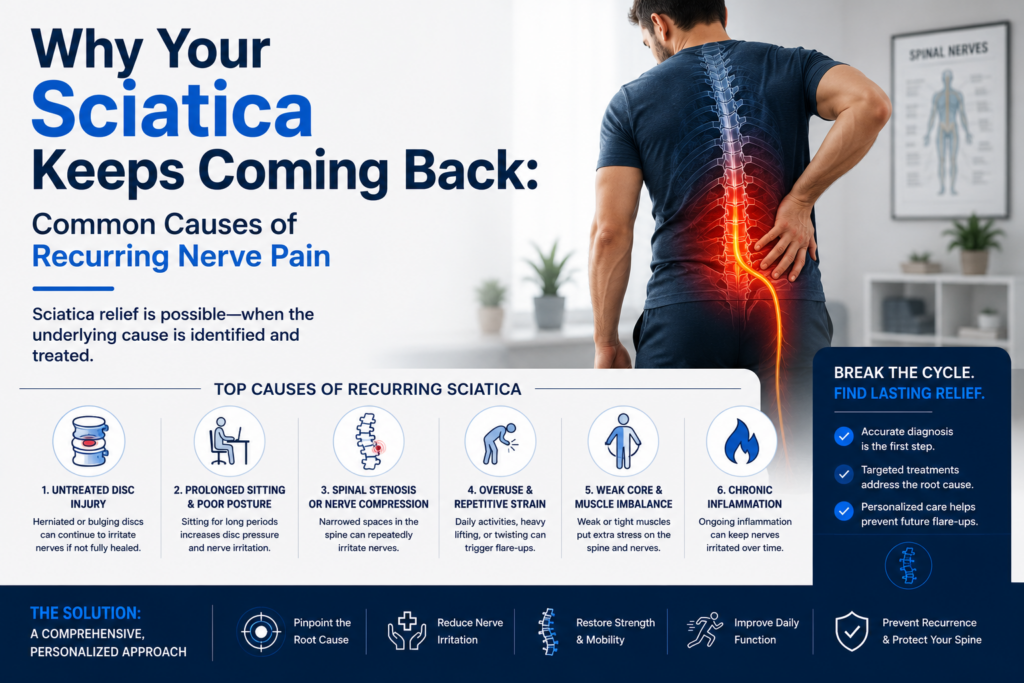
Why Your Sciatica Keeps Coming Back
One of the most frustrating experiences for patients dealing with sciatica is believing the problem is finally resolved, only to have the pain return weeks or months later.
Many patients experience a pattern that looks something like this:
• Pain develops in the lower back and leg
• Treatment begins
• Symptoms improve temporarily
• Daily activities resume
• The pain suddenly returns
For patients throughout New York City and Connecticut, recurring sciatica is one of the most common reasons they seek a second opinion from a spine specialist.
The reality is that sciatica is not a diagnosis.
Sciatica is a symptom.
When the underlying cause of nerve irritation is not fully addressed, symptoms often continue returning.
Understanding why sciatica recurs is the first step toward achieving long term relief rather than temporary symptom management.
What Is Sciatica?
Sciatica refers to pain that travels along the sciatic nerve.
The sciatic nerve begins in the lower spine and travels through:
• The buttocks
• The hips
• The thighs
• The calves
• The feet
When nerve roots become irritated or compressed, patients may experience:
• Sharp leg pain
• Burning sensations
• Tingling
• Numbness
• Weakness
• Electrical shock sensations
Sciatica may affect one leg or occasionally both depending on the underlying condition.
Why Temporary Relief Does Not Mean the Problem Is Gone
Many patients assume that symptom improvement means healing has occurred.
Unfortunately, pain reduction does not always mean the underlying issue has resolved.
Several treatments can temporarily reduce inflammation and discomfort, including:
• Medication
• Steroid injections
• Physical therapy
• Rest
• Activity modification
While symptoms may improve, the structural or mechanical cause of nerve irritation may still exist.
This is one of the primary reasons sciatica returns.
Herniated Discs Are the Most Common Cause of Recurring Sciatica
One of the most frequent causes of recurring sciatica is a herniated disc.
A herniated disc occurs when inner disc material pushes through damaged outer fibers.
This may result in:
• Nerve compression
• Inflammation
• Mechanical irritation
Even when symptoms improve initially, the injured disc may remain vulnerable.
Patients often experience recurrence after:
• Lifting heavy objects
• Long periods of sitting
• Travel
• Physical activity
• Poor posture
Without addressing the underlying disc injury, flare ups may continue occurring.
The Role of Inflammation in Recurring Sciatica
Many patients focus solely on nerve compression.
However, inflammation often plays an equally important role.
Damaged discs may release inflammatory chemicals that irritate nearby nerves.
Even when compression is relatively mild, inflammation may create:
• Burning pain
• Tingling
• Sensitivity
• Numbness
• Muscle tightness
When inflammation decreases, symptoms improve.
When inflammation returns, symptoms often return as well.
This cycle can continue for months or years.
Why Sitting Makes Sciatica Worse
Patients in New York City frequently spend long hours:
• Commuting
• Working at desks
• Traveling
• Driving
• Attending meetings
Sitting increases pressure within spinal discs.
This additional pressure may:
• Aggravate herniations
• Increase inflammation
• Irritate nerve roots
• Trigger flare ups
Many patients notice that sitting becomes their biggest symptom trigger.
The Hidden Problem of Annular Tears
One frequently overlooked cause of recurring sciatica is an annular tear.
An annular tear develops when small cracks form within the outer layer of the disc.
These injuries may:
• Trigger inflammation
• Increase disc sensitivity
• Irritate nearby nerves
• Cause recurring flare ups
Because annular tears are often subtle on imaging, many patients never realize they are present.
This can result in repeated treatment failures and ongoing symptoms.
Degenerative Disc Disease and Recurring Nerve Pain
As discs age, they gradually lose hydration and flexibility.
This process is known as degenerative disc disease.
Degeneration may contribute to:
• Disc collapse
• Nerve irritation
• Joint stress
• Mechanical instability
• Recurring inflammation
Patients frequently experience periods of improvement followed by symptom recurrence as degeneration progresses.
Why Physical Therapy Sometimes Fails
Physical therapy remains an important component of sciatica treatment.
However, not every rehabilitation program addresses the true cause of symptoms.
Some patients receive generalized exercises that fail to account for:
• Disc injuries
• Annular tears
• Instability
• Nerve irritation
• Movement dysfunction
When the diagnosis is incomplete, therapy may provide temporary relief without resolving the underlying issue.
Muscle Tightness Is Often a Symptom, Not the Cause
Many patients are told that tight muscles are causing their sciatica.
While muscle tightness frequently accompanies sciatica, it is often a response to nerve irritation rather than the primary problem.
Muscles may tighten in an attempt to:
• Protect the spine
• Limit movement
• Reduce pain
Treating only muscle tension may provide short term relief while allowing the underlying condition to persist.
Spinal Stenosis and Recurring Sciatica
Spinal stenosis occurs when spaces surrounding the nerves narrow.
This condition becomes more common with age.
Symptoms often include:
• Leg pain
• Numbness
• Weakness
• Pain while walking
• Recurring flare ups
Because stenosis tends to progress gradually, symptoms may improve temporarily before returning again.
Lifestyle Factors That Contribute to Recurrence
Several everyday habits increase the likelihood of recurring sciatica.
Common contributors include:
• Prolonged sitting
• Poor posture
• Weak core muscles
• Lack of movement
• Excess body weight
• Smoking
• Frequent travel
• High stress levels
Patients who fail to address these factors often experience recurring symptoms despite treatment.
Why Travel Frequently Triggers Sciatica
Many Morrison Clinic patients split time between Florida, New York City, and Connecticut.
Travel often creates ideal conditions for flare ups.
Common triggers include:
• Long flights
• Carrying luggage
• Sitting for extended periods
• Reduced exercise
• Poor sleep
• Changes in routine
Patients frequently report symptom recurrence after travel even when they were previously feeling well.
How Stress Affects Nerve Pain
Stress influences both physical and neurological responses.
Chronic stress may increase:
• Muscle tension
• Inflammation
• Pain sensitivity
• Fatigue
• Sleep disruption
Over time, stress may contribute to worsening symptoms and slower recovery.
Why Injections May Only Provide Temporary Relief
Epidural steroid injections can reduce inflammation around irritated nerves.
Many patients experience meaningful short term improvement.
However, injections typically do not:
• Repair damaged discs
• Correct instability
• Reverse degeneration
• Eliminate mechanical stress
When the effects wear off, symptoms may return if the underlying condition remains active.
The Importance of Accurate Diagnosis
The most effective sciatica treatment begins with understanding exactly why the nerve is irritated.
Potential causes include:
• Herniated discs
• Annular tears
• Spinal stenosis
• Degenerative disc disease
• Instability
• Joint dysfunction
• Inflammatory conditions
Each condition requires a different treatment strategy.
Accurate diagnosis is often the difference between recurring symptoms and lasting improvement.
Modern Approaches to Treating Recurring Sciatica
Modern spine care increasingly focuses on identifying and treating the true pain generator.
Treatment may include:
• Advanced diagnostic evaluation
• Targeted rehabilitation
• Image guided procedures
• Core stabilization
• Postural correction
• Regenerative medicine approaches
• Inflammation management
The goal is not simply reducing pain temporarily.
The goal is reducing the likelihood of future recurrence.
Signs Your Sciatica Needs Further Evaluation
Patients should seek additional evaluation if:
• Symptoms repeatedly return
• Pain persists longer than three months
• Weakness develops
• Numbness worsens
• Sitting becomes increasingly difficult
• Previous treatments have failed
Recurring symptoms often indicate that the root cause remains active.
Questions Patients Should Ask
Patients experiencing recurring sciatica should ask:
• What is causing my nerve irritation?
• Why does the pain keep returning?
• Is a disc injury involved?
• Could an annular tear be contributing?
• What treatments address the underlying cause?
• How can recurrence be prevented?
These questions often lead to more meaningful conversations about long term solutions.
Preventing Future Sciatica Flare Ups
While no treatment can eliminate all future risk, patients can significantly reduce recurrence by:
• Maintaining spinal mobility
• Strengthening core muscles
• Improving posture
• Reducing prolonged sitting
• Managing body weight
• Staying physically active
• Following individualized treatment recommendations
Long term prevention requires consistency rather than quick fixes.
Conclusion
Recurring sciatica is rarely random.
When symptoms continue returning, there is usually an underlying reason.
For many patients, the true cause may involve:
• Herniated discs
• Annular tears
• Degenerative changes
• Chronic inflammation
• Mechanical dysfunction
• Lifestyle related stressors
The key to lasting relief is identifying why the nerve remains irritated rather than simply treating symptoms when they appear.
For patients in New York City and Connecticut dealing with recurring nerve pain, a comprehensive evaluation may reveal the answers that previous treatments failed to uncover and provide a clearer path toward long term recovery.
