

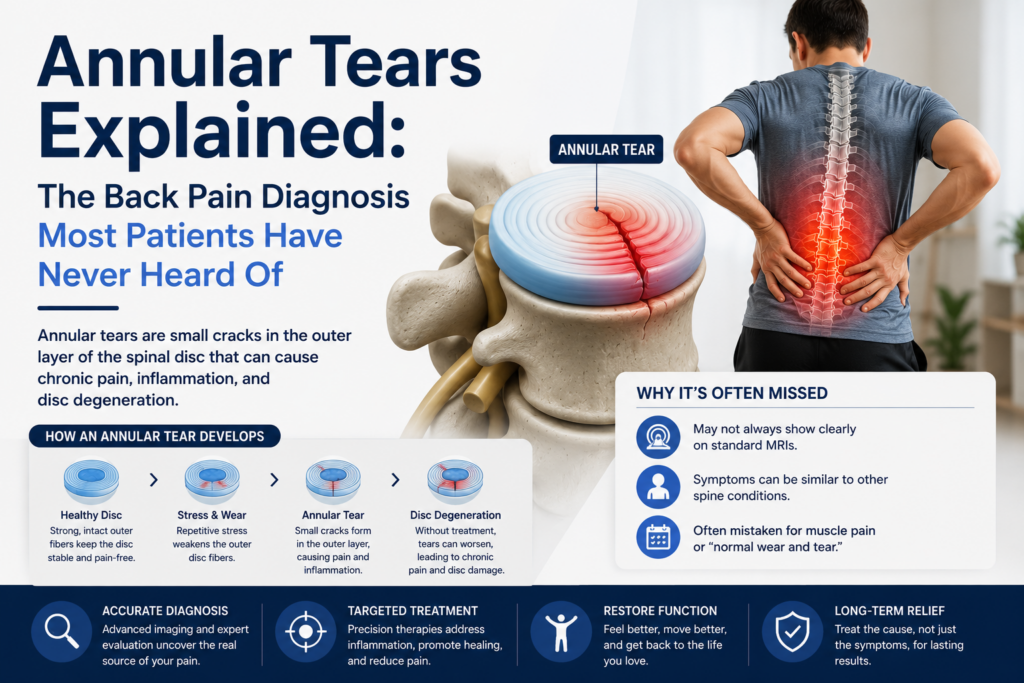
What Is an Annular Tear?
When most people think about spinal injuries, they think about herniated discs, sciatica, arthritis, or spinal stenosis.
Very few patients have ever heard of an annular tear.
Yet annular tears are one of the most common and overlooked causes of chronic back pain.
For many patients throughout New York City and Connecticut, an annular tear may be responsible for months or even years of unexplained pain despite multiple doctor visits, imaging studies, physical therapy programs, injections, and medication.
Many patients are told:
• Their MRI looks normal
• Their pain is muscular
• They simply need more exercise
• Nothing serious is wrong
Meanwhile, their pain continues.
Understanding annular tears may help explain why so many patients struggle to find answers despite seeking treatment from multiple providers.
Understanding the Structure of a Spinal Disc
To understand annular tears, it helps to understand how spinal discs work.
The spine contains discs positioned between each vertebra.
These discs serve several important functions:
• Shock absorption
• Load distribution
• Flexibility
• Movement support
• Protection of spinal structures
Each disc consists of two primary components.
The inner portion is called the nucleus pulposus.
This soft gel like center absorbs pressure and helps cushion movement.
Surrounding the nucleus is a stronger outer layer called the annulus fibrosus.
The annulus contains multiple layers of tough fibrous tissue designed to keep the inner disc material contained.
An annular tear develops when these outer fibers become damaged.
What Causes an Annular Tear?
Annular tears often develop gradually.
Contrary to popular belief, they do not always result from a major injury.
Common causes include:
• Repetitive bending
• Prolonged sitting
• Poor posture
• Heavy lifting
• Twisting movements
• Degenerative disc changes
• Athletic overuse
• Years of cumulative spinal stress
Many patients cannot identify a specific event that caused their symptoms.
Instead, the disc experiences gradual wear until the outer layers begin to develop small fissures or tears.
Why Annular Tears Are Often Missed
One of the biggest challenges with annular tears is diagnosis.
Unlike large disc herniations, annular tears may be difficult to identify on routine imaging.
Even when MRI scans reveal abnormalities, they are sometimes dismissed as insignificant findings.
Many patients receive reports mentioning:
• Mild degeneration
• Small disc bulges
• Minor changes
• Normal age related findings
Yet the actual source of pain may be an annular tear causing significant inflammation.
This creates one of the most frustrating experiences in spine care.
The patient knows something is wrong.
The pain is real.
But imaging findings may appear relatively mild.
Why Annular Tears Hurt So Much
Many people assume a small tear should not create significant symptoms.
The reality is that the outer portion of the disc contains nerve fibers.
When the annulus becomes damaged:
• Inflammation develops
• Pain receptors activate
• Chemical irritants are released
• Nerve sensitivity increases
• Disc pressure becomes painful
This can create symptoms that are far more severe than the imaging findings suggest.
In many cases, the pain comes not from compression but from inflammation and chemical irritation.
Common Symptoms of an Annular Tear
Symptoms vary depending on location and severity.
Common complaints include:
• Chronic low back pain
• Pain while sitting
• Pain during bending
• Pain during lifting
• Pain while driving
• Morning stiffness
• Intermittent flare ups
• Pain that improves with standing
Many patients report that sitting is their biggest trigger.
This is especially common among professionals in New York City who spend long hours:
• At a desk
• Commuting
• Traveling
• Working remotely
• Attending meetings
Because sitting increases pressure within the discs, symptoms often worsen dramatically during prolonged seated activities.
How Annular Tears Differ From Herniated Discs
Annular tears and herniated discs are related but not identical.
An annular tear involves damage to the outer disc fibers.
A herniated disc occurs when inner disc material pushes through those damaged fibers.
Not every annular tear becomes a herniation.
Not every herniation originates from a painful annular tear.
However, annular tears frequently represent an earlier stage of disc injury.
This is one reason proper diagnosis matters.
Treating the problem early may help prevent progression.
Why Patients Often Receive the Wrong Diagnosis
Many patients with annular tears receive alternative explanations for their symptoms.
Common misdiagnoses include:
• Muscle strain
• General low back pain
• Arthritis
• Tight hamstrings
• Postural pain
• Nonspecific mechanical pain
While some patients may have multiple contributing factors, the underlying disc injury may remain unrecognized.
This often leads to months or years of ineffective treatment.
Why Physical Therapy Sometimes Fails
Physical therapy can be extremely beneficial for many spinal conditions.
However, annular tears create unique challenges.
Certain movements may increase pressure inside the injured disc.
If treatment focuses solely on strengthening without considering disc irritation, symptoms may worsen.
Patients often report:
• Temporary improvement
• Recurring flare ups
• Increased pain during exercises
• Difficulty progressing rehabilitation
The issue is not necessarily the therapy itself.
The issue is ensuring treatment aligns with the actual diagnosis.
Why Sitting Makes Annular Tears Worse
One of the hallmark characteristics of annular tears is sitting intolerance.
Research has shown that sitting increases intradiscal pressure.
As pressure rises:
• Damaged fibers experience more stress
• Inflammation increases
• Pain receptors become activated
• Symptoms intensify
Patients often describe:
• Pain during flights
• Pain while driving
• Pain during office work
• Pain while dining
• Pain while watching television
Standing and walking frequently provide relief because pressure inside the disc decreases.
The Connection Between Annular Tears and Sciatica
Annular tears do not always cause sciatica.
However, inflammation from the injured disc may irritate nearby nerves.
This can create:
• Leg pain
• Tingling
• Burning sensations
• Numbness
• Intermittent nerve symptoms
Some patients experience classic sciatica despite relatively minor MRI findings.
Again, inflammation often explains the discrepancy.
Why Anti Inflammatory Medication Is Usually Not Enough
Medication may temporarily reduce inflammation.
Common treatments include:
• NSAIDs
• Muscle relaxers
• Pain medication
While these approaches may reduce symptoms, they rarely address:
• Disc integrity
• Mechanical stress
• Underlying dysfunction
This is why symptoms often return after treatment ends.
How Modern Spine Specialists Diagnose Annular Tears
Modern evaluation involves more than simply reviewing an MRI report.
Comprehensive assessment may include:
• Detailed symptom history
• Physical examination
• MRI interpretation
• Functional movement assessment
• Neurological testing
The goal is identifying whether the disc itself is acting as the primary pain generator.
Accurate diagnosis often changes the entire treatment strategy.
Modern Treatment Approaches for Annular Tears
Treatment depends on severity and patient specific factors.
Modern options may include:
• Activity modification
• Physical rehabilitation
• Core stabilization
• Movement correction
• Image guided procedures
• Regenerative treatment approaches
• Inflammation management
The goal is reducing stress on the injured disc while promoting long term recovery.
Why Early Diagnosis Matters
Many patients live with symptoms for years before receiving an accurate diagnosis.
Unfortunately, prolonged irritation may contribute to:
• Disc degeneration
• Chronic inflammation
• Reduced function
• Progressive instability
• Greater treatment complexity
Earlier diagnosis often creates more treatment opportunities.
Lifestyle Factors That Slow Recovery
Several daily habits may aggravate annular tears.
Common contributors include:
• Long periods of sitting
• Poor posture
• Frequent travel
• Weak core muscles
• Limited mobility
• Repetitive lifting
• Smoking
• Poor sleep quality
Patients traveling between Florida, NYC, and Connecticut frequently notice flare ups during periods of increased sitting and reduced activity.
Addressing these factors is often a critical part of long term improvement.
Questions Patients Should Ask
Patients experiencing chronic unexplained back pain should ask:
• Could an annular tear be causing my symptoms?
• Does my MRI show signs of disc injury?
• Why does sitting make my pain worse?
• Why have previous treatments failed?
• What treatment options target the disc itself?
• How can I prevent further degeneration?
These questions often lead to more productive discussions regarding diagnosis and treatment.
When to Seek Evaluation
Patients should seek further evaluation if they experience:
• Chronic pain lasting longer than three months
• Pain that worsens while sitting
• Recurring flare ups
• Sciatica symptoms
• Failure of previous treatments
• Pain that limits daily activities
Persistent symptoms deserve a thorough investigation.
Conclusion
Annular tears remain one of the most overlooked causes of chronic back pain.
Although many patients have never heard the term before, these disc injuries may explain why so many people continue experiencing pain despite normal or minimally abnormal imaging findings.
The pain is real.
The condition is common.
And proper diagnosis can make a significant difference in determining the most effective treatment strategy.
For patients in New York City and Connecticut dealing with persistent back pain, understanding annular tears may be the missing piece that finally explains why symptoms continue and what steps may help create lasting improvement.
