

Chronic back pain and neck pain affect millions of people every year. For many patients, the discomfort becomes severe enough to interfere with work, sleep, exercise, and daily life. When conservative treatments such as physical therapy, medications, and injections fail to provide relief, many patients are told that spine surgery may be the next step.
However, surgery is not the only option available today.
Advancements in modern spine care have introduced innovative treatments designed to address the root causes of disc-related pain without requiring major surgical procedures. One such approach is the Discseel® Procedure, a minimally invasive treatment that aims to repair damaged spinal discs and relieve chronic pain.
Patients seeking treatment for herniated discs, bulging discs, or degenerative disc disease are increasingly exploring alternatives to spine surgery. The Discseel procedure is gaining attention because it focuses on repairing damaged discs rather than removing or fusing them.
Understanding the differences between Discseel and traditional spine surgery can help patients make informed decisions about their treatment options.
In this guide, we will explore:
• what causes disc-related spine pain
• how traditional spine surgery works
• how the Discseel procedure works
• key differences between these treatments
• benefits and limitations of each approach
• which patients may be candidates for Discseel
By understanding these options, patients can better evaluate whether a minimally invasive treatment may be the right solution for their spine condition.
Understanding Disc-Related Spine Pain
Most cases of chronic back pain originate from problems with the spinal discs.
Spinal discs sit between the vertebrae and act as cushions that absorb pressure and allow flexibility in the spine.
Each disc contains two main components.
Annulus fibrosus
The tough outer ring of the disc that provides structure and stability.
Nucleus pulposus
The soft, gel-like center that helps absorb shock during movement.
Over time or due to injury, the outer ring of the disc can develop small tears called annular tears. These tears may allow disc material to leak outward and irritate surrounding nerves.
This damage can lead to several common spine conditions.
| Spine Condition | Description |
|---|---|
| Herniated Disc | Disc material pushes through the outer layer |
| Bulging Disc | Disc protrudes beyond its normal boundary |
| Degenerative Disc Disease | Disc deterioration over time |
| Radiculopathy | Nerve pain radiating into arms or legs |
| Chronic Back Pain | Persistent disc-related pain |
These conditions often cause symptoms such as:
• lower back pain
• neck pain
• nerve pain in the arms or legs
• numbness or tingling
• muscle weakness
When these symptoms persist despite treatment, doctors may recommend more advanced interventions.
Traditional Spine Surgery for Disc Problems
Spine surgery is sometimes necessary when severe nerve compression or spinal instability occurs.
Common spine surgeries include:
| Procedure | Purpose |
|---|---|
| Discectomy | Removal of damaged disc material |
| Laminectomy | Removal of bone to relieve nerve pressure |
| Spinal Fusion | Joining vertebrae together to stabilize the spine |
| Artificial Disc Replacement | Replacing a damaged spinal disc |
These procedures aim to relieve pressure on nerves or stabilize the spine.
However, traditional spine surgery is typically considered a last resort, especially when non-surgical treatments fail to relieve symptoms.
Limitations of Traditional Spine Surgery
While spine surgery can be effective in certain cases, it also has several limitations that patients should consider.
Long Recovery Time
Major spine surgeries often require extended recovery periods.
Patients may need weeks or months to fully recover.
Loss of Natural Spine Movement
Procedures such as spinal fusion permanently join vertebrae together. This can reduce flexibility in the spine.
Surgical Risks
All surgical procedures carry some risk, including:
• infection
• bleeding
• nerve damage
• complications from anesthesia
Adjacent Segment Stress
Spinal fusion can increase stress on nearby discs, which may lead to future degeneration in those areas.
Because of these limitations, many patients seek alternatives that preserve the natural structure of the spine.
What Is the Discseel® Procedure?
The Discseel® Procedure is a minimally invasive treatment designed to repair damaged spinal discs.
Unlike traditional surgery, which often removes or fuses spinal structures, Discseel focuses on sealing tears in the disc itself.
This procedure uses a biologic substance called fibrin sealant, which is naturally involved in the body’s healing process.
Fibrin helps form blood clots and promotes tissue repair.
During the Discseel procedure, fibrin sealant is injected into the damaged disc under imaging guidance.
The fibrin works to:
• seal annular tears
• stabilize the disc
• prevent leakage of inflammatory disc material
• promote disc healing
By repairing the damaged disc, the procedure aims to relieve pain while preserving natural spinal movement.
How the Discseel Procedure Is Performed
The Discseel procedure is performed using advanced imaging technology to ensure precision and safety.
Step 1: Diagnostic Imaging
Before the procedure, imaging studies such as MRI scans help identify discs that may be causing pain.
A diagnostic test called an annulogram may be used to confirm the presence of annular tears.
This test involves injecting contrast dye into the disc to detect leakage from tears.
Step 2: Fluoroscopic Guidance
Fluoroscopy, a type of real-time X-ray imaging, guides the physician during the procedure.
This allows the physician to precisely locate the damaged disc.
Step 3: Fibrin Injection
Once the damaged disc is identified, fibrin sealant is injected into the disc.
The fibrin spreads through the disc and seals the tears.
Over time, the fibrin integrates with the disc tissue and promotes healing.
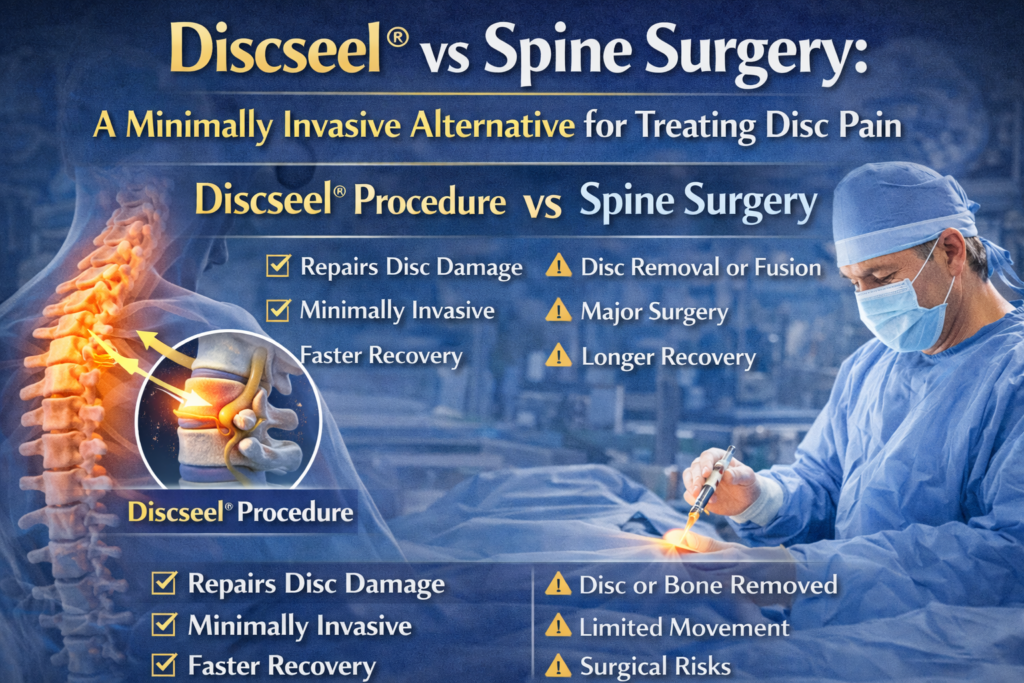
Discseel vs Spine Surgery: Key Differences
Understanding the differences between these two treatment approaches can help patients evaluate their options.
| Feature | Discseel Procedure | Traditional Spine Surgery |
|---|---|---|
| Invasiveness | Minimally invasive | Major surgical procedure |
| Goal | Seal disc tears and promote healing | Remove or fuse damaged structures |
| Recovery Time | Usually faster | Weeks to months |
| Preservation of Movement | Maintains natural spine movement | Fusion may reduce movement |
| Surgical Risks | Lower | Higher due to open surgery |
| Hospital Stay | Often same-day procedure | May require hospitalization |
These differences explain why many patients consider Discseel before choosing major spine surgery.
Benefits of the Discseel Procedure
The Discseel procedure offers several advantages for patients suffering from chronic disc-related pain.
Minimally Invasive Treatment
The procedure does not involve large surgical incisions.
Faster Recovery
Because the procedure is less invasive, recovery is often quicker.
Preservation of Natural Spine Function
Discseel repairs the disc rather than removing it.
Targeting the Root Cause of Pain
By sealing annular tears, the procedure addresses the source of disc leakage and inflammation.
Reduced Surgical Risks
Minimally invasive procedures generally carry fewer risks compared with major surgery.
Who May Be a Candidate for the Discseel Procedure?
The Discseel procedure may be appropriate for patients experiencing:
• chronic lower back pain
• neck pain
• herniated discs
• bulging discs
• degenerative disc disease
• nerve pain caused by disc damage
Patients who have not found relief from physical therapy, medications, or injections may benefit from evaluation by a spine specialist.
A thorough medical evaluation is required to determine whether Discseel is the right treatment option.
Recovery After the Discseel Procedure
Recovery from the Discseel procedure is generally quicker than recovery from major spine surgery.
Most patients can return home shortly after the procedure.
Recovery typically includes:
• limited activity for a short period
• gradual return to daily activities
• follow-up visits with the physician
Many patients experience improvement as the disc heals over time.
When Spine Surgery May Still Be Necessary
Although minimally invasive treatments offer many advantages, spine surgery is still necessary in certain situations.
Surgery may be required if:
• severe spinal instability exists
• tumors affect the spine
• spinal fractures occur
• advanced nerve compression is present
In these cases, surgical intervention may be the safest and most effective treatment.
Protecting Long-Term Spine Health
Maintaining a healthy spine can reduce the risk of future disc problems.
Helpful habits include:
• maintaining good posture
• exercising regularly
• strengthening core muscles
• avoiding heavy lifting injuries
• maintaining a healthy body weight
Preventive care plays an important role in protecting spinal health over time.
Frequently Asked Questions
Is Discseel a type of surgery?
Discseel is considered a minimally invasive procedure rather than traditional open surgery.
How long does the Discseel procedure take?
The procedure typically takes less time than major spine surgery.
How soon can patients return to normal activities?
Many patients resume light activities relatively quickly, although recovery times may vary.
Is Discseel safer than spine surgery?
Because the procedure is minimally invasive, it may carry fewer risks than major surgery, but suitability depends on the patient’s condition.
Final Thoughts
Chronic back pain can significantly impact quality of life, especially when traditional treatments fail to provide relief. While spine surgery remains necessary in certain situations, many patients are now exploring minimally invasive alternatives that focus on repairing damaged discs rather than removing them.
The Discseel® Procedure represents an innovative approach to treating disc-related spine pain by sealing annular tears and promoting natural healing within the disc.
By preserving the natural structure and function of the spine, this treatment offers a potential alternative for patients seeking relief without undergoing major surgery.
Patients experiencing persistent disc-related pain should consult a qualified spine specialist to determine whether treatments such as Discseel may be appropriate for their condition.
Early diagnosis and expert evaluation remain essential for achieving the best possible outcomes in spine care.
